Courtesy the Lego folks, here's a cute Star Wars fan film that retells episodes IV-VI with Jar Jar Binks represented.

Thursday, November 4, 2010
Note to Politicians: Ignore the Young


Is it finally time to end our fascination with the youth vote?
During the 2008 Democratic primary campaign, I had an ongoing friendly debate with an Obama-supporting friend. I, a Clinton supporter, argued in favor of Hillary's experience, pragmatism, and general outlook. My friend was smitten by Obama's newness and optimism.
A recurring theme in any such discussion of Obama's 2008 campaign is its strong appeal to young voters. I acknowledged that at the time, but I warned my friend that young people are fickle in their political involvement. The real test for them would not be if they could stay sober enough and put down the Wii controls long enough to head to the voting booths in November 2008, but it would come two and four years later, when their naive assumptions about how Obama would govern would be tested by the necessary compromises and inevitable defeats along the way.

Not to put too fine a point on it, but I was correct. Sadly so, because I think Obama's a very fine president and I fully expect vote for him again in 2012. But young voters were one of the heavily underrepresented populations in the recent midterm elections.
So is it finally time to stop worshipping at the alter of youth? I know that's a terribly un-American thing to say, but if your campaign (and eventual re-election) is based on getting support from people who ultimately don't believe in the responsibilities of voting and representative government, then doesn't that suggest a flaw in your strategic governing approach?
During the 2008 Democratic primary season, The New Republic's Leon Wieseltier wrote a rather good short essay entitled "Forever Young." Responding to the Obama supporters' desire for newness, freshness, someone untainted by actual experience, he argued that there can be something as too young:
I don't mean to hold up Wieseltier as any great sage; I think he's gone over to the demagogic side of life in recent years, which puts the nail in the coffin of my former reverence for The New Republic (my political bible during the 1980s). But I think he puts it nicely about the deficiencies in this endless (and groundless) belief in the virtues of newness and youth. I would take that line of argument further and say there's a related problem: the American faith in the virtue of fast decisions, in fast results.
People who don't vote often and are only induced to vote when they're unnaturally angry or unnaturally inspired are also people who will not stick with the political process for their problems to be sorted out the way problems have been sorted out for centuries in civil societies: slowly, patiently, frankly conservatively, and usually the fairer for it.
Corina Casanova, the federal chancellor of Switzerland, recently compared California's love of citizen initiatives with her own country's famed use of such direct democracy. There were many similarities between the two political systems, she noted, but Switzerland is willing to invest more time in considering each initiative and trying to come up with alternatives, counter-proposals, and compromises that suit everyone. As a result, many of the initiatives are ultimately withdrawn, many more have compromises and counter-proposals debated and voted on by the government, and fewer than 10 percent win voter approval. Compare that to California's more do-it-now, don't-consider-the-alternatives system, in which one-third of initiatives are voter-approved but there is no system to work out compromise and deal with the underlying difficulties that created the citizen demand for the initiative in the first place. "The essential consequence of this cultural difference is that considerably longer periods of time are allotted in Switzerland for the handling of popular initiatives," Casanova said.
Time is a buzz-kill. You can't keep people with short attention spans interested when problems move beyond the emotional chest-beating stage and turn into committee hearings and legislative wrangling. Sooner or later, you need adults to do the hard work, and if you've only voted in people who are "forever young," then you're in trouble.
During the 2008 Democratic primary campaign, I had an ongoing friendly debate with an Obama-supporting friend. I, a Clinton supporter, argued in favor of Hillary's experience, pragmatism, and general outlook. My friend was smitten by Obama's newness and optimism.
A recurring theme in any such discussion of Obama's 2008 campaign is its strong appeal to young voters. I acknowledged that at the time, but I warned my friend that young people are fickle in their political involvement. The real test for them would not be if they could stay sober enough and put down the Wii controls long enough to head to the voting booths in November 2008, but it would come two and four years later, when their naive assumptions about how Obama would govern would be tested by the necessary compromises and inevitable defeats along the way.

Not to put too fine a point on it, but I was correct. Sadly so, because I think Obama's a very fine president and I fully expect vote for him again in 2012. But young voters were one of the heavily underrepresented populations in the recent midterm elections.
So is it finally time to stop worshipping at the alter of youth? I know that's a terribly un-American thing to say, but if your campaign (and eventual re-election) is based on getting support from people who ultimately don't believe in the responsibilities of voting and representative government, then doesn't that suggest a flaw in your strategic governing approach?
During the 2008 Democratic primary season, The New Republic's Leon Wieseltier wrote a rather good short essay entitled "Forever Young." Responding to the Obama supporters' desire for newness, freshness, someone untainted by actual experience, he argued that there can be something as too young:
"False hopes?" Obama told a crowd in New Hampshire. "There's no such thing." How dare he? There is almost no more commonplace trait of human existence (and of African American existence) than false hopes. … After Bush, who is not for a fresh start? But there is something unfresh about Obama's movement for freshness. … [C]an we agree on a ground between cynicism and myth? Or must we have Camelot once more? After all, being young again is also a way of living in the past. There was something mildly farcical about the Kennedys' endorsement of Obama – of this candidacy that is alleged to signify an alternative to the dynasties, and a break with ideological antiquity; but worst of all was its brazen delight in mythologization. (Thanks to the Obama campaign, millions of Americans now hold that John Kennedy was a great president and that Lyndon Johnson was not responsible for making civil rights and voting rights into law.) I understand that no one, except perhaps Lincoln, ever ran for the presidency on a tragic sense of life; but if it is possible to be too old in spirit, it is possible also to be too young.It's not that young people don't vote. It's that you can't talk about young people (let's just roughly define them as people from 18 to 30 years of age) without piling on the qualifiers. They don't vote much. They don't vote consistently. They aren't informed enough when they vote. They lack long-term perspective about the effects of their votes. Even if you try to qualify the qualifiers by pointing out the dreadful ignorance of most voters, it doesn't help to correct it even further and say that young people are even worse.
I don't mean to hold up Wieseltier as any great sage; I think he's gone over to the demagogic side of life in recent years, which puts the nail in the coffin of my former reverence for The New Republic (my political bible during the 1980s). But I think he puts it nicely about the deficiencies in this endless (and groundless) belief in the virtues of newness and youth. I would take that line of argument further and say there's a related problem: the American faith in the virtue of fast decisions, in fast results.
People who don't vote often and are only induced to vote when they're unnaturally angry or unnaturally inspired are also people who will not stick with the political process for their problems to be sorted out the way problems have been sorted out for centuries in civil societies: slowly, patiently, frankly conservatively, and usually the fairer for it.
Corina Casanova, the federal chancellor of Switzerland, recently compared California's love of citizen initiatives with her own country's famed use of such direct democracy. There were many similarities between the two political systems, she noted, but Switzerland is willing to invest more time in considering each initiative and trying to come up with alternatives, counter-proposals, and compromises that suit everyone. As a result, many of the initiatives are ultimately withdrawn, many more have compromises and counter-proposals debated and voted on by the government, and fewer than 10 percent win voter approval. Compare that to California's more do-it-now, don't-consider-the-alternatives system, in which one-third of initiatives are voter-approved but there is no system to work out compromise and deal with the underlying difficulties that created the citizen demand for the initiative in the first place. "The essential consequence of this cultural difference is that considerably longer periods of time are allotted in Switzerland for the handling of popular initiatives," Casanova said.
Time is a buzz-kill. You can't keep people with short attention spans interested when problems move beyond the emotional chest-beating stage and turn into committee hearings and legislative wrangling. Sooner or later, you need adults to do the hard work, and if you've only voted in people who are "forever young," then you're in trouble.
Wednesday, November 3, 2010
Freejack Flub: The Starlog Project: Starlog #176, March 1992
 The Emilio Estevez vehicle Freejack is on the cover, but Starlog flubs up the cover in an embarrassing way. No, it’s not the grainy, badly outlined photo of Anthony Hopkins on the cover, though that hurts. No, it’s not the weird yellow-black-yellow bands of background color on the cover, though that mystifies. The mixup is evident when one looks at the small text on the lower left-hand portion of the cover, where the cover image is described: “Emilio Estevez as Furlong (left) & Anthony Hopkins as McCandless (right).” The problem? There’s no Estevez on the cover. It’s just Hopkin’s giant, somewhat blurry head.
Someone apparently switched the cover photo at the last minute but didn't switch the cover copy. Um, waitaminnit ...
Oh, dear lord ... I just realized what the cover is. It's two faces melded together. Estevez, y'see, is on the left (or at least half of his face is), and the right side of the head is Anthony Hopkins. And you know what? It still sucks.
All around, then, a crappy cover. Therefore, it’s fitting that it features Freejack, the movie that gives us a Mick-Jagger/Emilio-Estevez/Anthony-Hopkins trio of underperforming performers. And to think this weak film was based on a story by the great Robert Sheckley. Sad.
Just keep repeating to yourself: It’s only a movie, it’s only a movie, it’s only a movie ...
Also this issue, Starlog publishes its annual postal statement of ownership and circulation. The total paid circulation for the issue closest to the statement's filing deadline is listed as 164,074 (down from the previous year's 171,137), including the number of paid subscriptions of 9,521 (barely changed from 9,567 last year).
Starlog #176
80 pages (including covers)
Cover price: $4.95
Freejack pretty much tanked at the box office. But perhaps you liked The Addams Family reboot more. Well, Starlog’s hoping you will, because it’s publishing The Addams Family Official Movie Magazine. Includes “FREE! FOUR GIANT POSTERS.” As the ad on page 22 says, “Prepared by the Editors of FANGORIA! (SO YOU KNOW IT’S CREEPY!)”
 The rundown: As I mentioned above, Freejack is featured – if that’s the word – on the cover; but on the contents page, a “Rebellious Kathy Ireland” promotes Dick & Marge Save the World (apparently an alternate title for the Teri Garr opus Mom & Dad Save the World). Meanwhile, Communications letters range from Terminator 2 speculation to never-ending Star Trek debates to follow-up to David Hirsch’s #172 article on composer Leonard Rosenman, plus Mike Fisher’s Creature Profile features the Bride of Frankenstein.
David McDonnell’s Medialog column gives us first word on Harve Bennett’s newest upcoming syndicated TV series, Time Trax; Booklog reviews The Garden of Rama, Martian Rainbow, The Revenge of the Rose, Jack the Bodiless, Prince of Chaos, and Jinx High; David Hutchison’s Videolog column announces the release of The Rocketeer and other genre titles; the Fan Network pages include Lia Pelosi’s directory of fan clubs and publications, plus the convention calendar; Bill Wilson reports on one of the most exciting developments in the genre in the early 1990s: the birth of The Sci Fi Channel, and he goes behind the scenes to look at plans for the new cable channel; and Kerry O’Quinn’s From the Bridge chats with George Lucas about his upcoming TV series The Young Indiana Jones Chronicles, and it includes this quote equivalent of a money shot, in which Lucas discusses who will and will not be interested in the program: “The exception is Starlog’s readership, especially the Star Trek group, who are more interested in ideas, generally, than in action. They like action, but I think that one of the things which makes Star Trek work is that it explores many very profound ideas in a dramatic context. That’s what I’m trying to do with this TV series.”
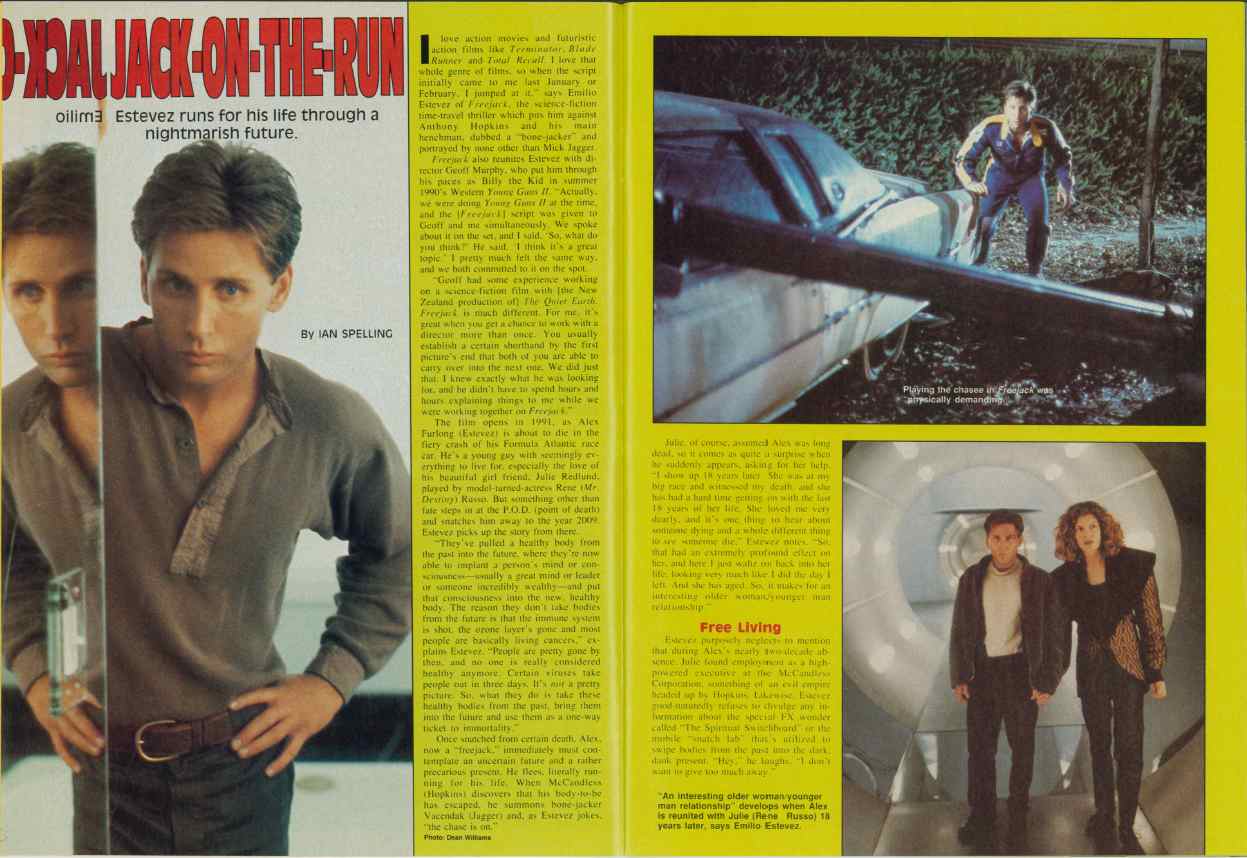
 Adam Pirani interviews Freejack’s Anthony Hopkins, who says of the role, “It’s just a chance to work. I’ve never been offered a science fiction thing before, so I just did it. No great reasons.” Ian Spelling talks to Hopkins’ costar Emilio Estevez, who was more enthusiastic when he was offered the role: “I jumped at it”; Adam Pirani also spoke with actress Kim Cattrall, who stars as the newest Vulcan character Valeris, and Marc Shapiro and Ian Spelling provide a sidebar in which Cattrall discusses the sexual connection between Valeris and Spock (and their controversial mind meld); Tom Weaver explores the comics version of Forbidden Planet; in “Miracle Worker,” Lynne Stephens talks to actor James Doohan about Star Trek VI: The Undiscovered Country; and Bill Warren profiles Jon Lovitz, who plays the comic ruler Tod Spengo in Dick & Marge Save the World or Mom & Dad Save the World – take your pick.
Ian Spelling interviews actor Wil Wheaton about his returns to Star Trek: The Next Generation and his post-Trek career; Marc Shapiro chats up model/actress Kathy Ireland; Mike Clark notes the recent death of producer Irwin Allen with a career retrospective; in another post-mortem article, Eric Niderost profiles the late actor Ralph Bellamy; and David McDonnell’s Liner Notes column discusses comics and movies.
“Great business concept or not, [Sci Fi Channell president and founder Mitchell] Rubenstein is quick to dispel any notion that such an idea sprang forth from the mind of a diehard SF aficionado. ‘I’m not a Trekkie in the sense that you or your readers would think of a Trekkie, though I do watch. I just don’t watch it over and over and over. When you come into my office, the first thing you notice is that there’s virtually no science-fiction memorabilia anywhere. I’m definitely not a fan in the traditional sense; I don’t go to conventions. I would put myself in the mainstream of those who watch science fiction, but aren’t fanatics about it. I would put myself more in the category of the “traditional” viewer we would hope to attract with the Sci-Fi Channel, though we do want the hardcore fans to watch, too. We recognize their importance to us.”
– Bill Wilson, writer: “I Want My SF-TV!”For more, click on Starlog Internet Archive Project below or visit the Starlog Project's permanent site.
Early Arrivals for San Francisco Giants Victory Parade


Saturday, October 30, 2010
Green Lantern vs. Captain America: Tale of Entertainment Weekly Superhero Hunks
 I have no idea if Green Lantern (a new film based on a superhero comic I never followed) and Captain America (based on another superhero comic I never followed) are going to be any good. As far as eye candy goes, though, it'll be a fun contest.
I admit to being pleased to see Chris Evans headline the Captain film; I thought he was fun to watch in the Fantastic Four films (again, based on a comic I never followed – frankly, superhero comics never were big for me).
But I'll have to give my preview vote to a third film, Green Hornet, for now, because it co-stars Chinese actor-singer Jay Chou, of whom I'm quite a fan. Unless I've missed it, Green Hornet has not yet gotten an Entertainment Weekly cover story. When it does, I say put Chou on the cover. I am primarily a fan of his music; he and David Tao are arguably the best at mixing R&B, rap, pop, and traditional Chinese music into powerful tunes.
 But I am also a fan of Chou's acting. You might remember him as one of the princes in Curse of the Golden Flower, and he was very good in that. But I think a film that fits him even better was his early starring role in Initial D, a Chinese drift-racing film from 2005.
So, hey, Entertainment Weekly: Where's Jay Chou's cover story?
Wednesday, October 27, 2010
China's New Bullet Trains Reminds Us U.S. is Standing Still

Meanwhile, California is still squabbling over building a north-to-south high-speed rail line in the state. The California version will travel slower than the 400 km/h of the Chinese trains, but much faster than the usual slow rail traffic in this country.
What's happened to us? Why aren't cutting-edge trains and bridges and skyscrapers being built here in the United States? Are we too lazy? (Okay, okay, so 7,430 kilometers equals 4,616.788 miles, and 400 km/h equals 248.54848 miles per hour -- so I've proven that Americans can reform.) Too cheap? Too worried about government spending needed to do giant infrastructure projects? Or – and I think this is the main reason – do we no longer care?
I can be tempted to sympathize with that last reason. I get easily tired of the boosterism of most people in most places, for whom being the biggest and best is a self-justifying pursuit. New Yorkers think they're the center of the universe. San Franciscans think they're the coolest people ever. Texans think nothing can't be made better by making it bigger and gaudier. And we'll easily get tired of the boosterism and the boasting of other countries, such as China's rapidly expanding national economy and ego.
But Americans' lack of interest in being cutting-edge on technology and infrastructure strikes me less as a modest and mature reaction to having achieved a great deal, and more like a rejection of the concept of advancement and technology (and science) altogether. I don't think it's a coincidence that our country's fundamentalist religions are gaining strength and political power at the same time as our country has lost its fascination with how the world really works. Instead, the new spiritualism seems more dedicated to defending how we feel things are, and that's not how science works.
You can't build a 248-mph bullet train without science. Jesus and St. Paul (and the Talmud and Dianetics and the Koran and every other religious source) didn't leave us directions on building bullet trains. That's okay. I don't want Deepak Chopra or Rev. Al Sharpton performing brain surgery or designing suspension bridges, and I don't want Sir Richard Branson or Steve Jobs giving me warmed-over Wired editorials as pop spirituality.
Defenders of America's drift often claim that China's able to do these giant leaps of technology because it has an authoritarian government. But Europe is filled with countries that are even more democratic than the United States, and they're building record-breaking tunnels and bridges and high-speed trains all across that continent.
Another tactic these defenders of staying put use is to argue that private enterprise will build these things in the United States, and we don't need government involvement and funding. If that were true, of course, we'd already have privately built high-speed rail here, but we don't. I'm all for a vibrant and expanding private sector; as I've written here before, I think one of the best things to happen to space technology has been the government's near-exit from the field and private industry's embrace. But let's face it: Private enterprise will be just as happy designing and building the trains and bridges and buildings in Asia or South America or wherever as they would be building them here. Whoever cuts them a check.
Yesterday I read these words by David Gergen, a longtime presidential aide and political commentator, that he spoke at The Commonwealth Club recently:
[T]he reason America became the number-one nation in the world was that we had the best educational system in the world. As of 1900 we were the most-educated people in the world, and we continued to improve the quality of education in this country right through the first decades of the 1900s. Every generation went to school on average two years more than their parents did, and that happened generation after generation after generation. As of the 1960s, we were number-one in college graduation rates in the world, and we had and continue to have the best universities in the world. But since the 1960s and ’70s, since that “Nation at Risk” report, we have actually gone downhill very rapidly. We are now number 15 in terms of college graduation rates. And you know a third of our kids are not finishing high school, another third finish but are not ready for college, not ready for 21st-century jobs, only a third come through the system. We talk about No Child Left Behind – it’s a joke; we are leaving millions of children behind. That’s because we haven’t come to deal yet with this chronic condition.Gergen identifies part of this overall decline, which is we're just feeding less-educated and less-equipped people into the world, while other countries are equipping their students better and better, all to the betterment of their economies.
I want bullet trains. I want spaceships. I want new cures for diseases. I want giant windmills offshore powering my cities. I want supercomputers. And I want them here, in the United States, as well as elsewhere.
But I fear the tidal forces of culture and history are going to hold back America for a while, until this new wave of superstition has run its course.
Tuesday, October 26, 2010
In the Wake of Gene Roddenberry: The Starlog Project: Starlog #175, February 1992

Starlog’s staff pulls out all of the stops for a 20-page salute to Roddenberry that includes contributions from many of the actors, writers, directors, and other artists who worked in the Trek universe, bookended by editor David McDonnell and former publisher Kerry O’Quinn, who knew Roddenberry well. In essence, it’s a print version of a wake for the man, and though it’d be overkill in most other magazines, it seems entirely appropriate in Starlog.
I do not remember who said this, but it has always stuck with me: The 1960s Star Trek series got worse as it progressed and creator Gene Roddenberry’s involvement was limited; however, Star Trek: The Next Generation got better as it progressed and Roddenberry’s involvement was limited. By noting that – and that I agree with it – I do not intend to slight Gene Roddenberry. If anything, it shows that the greater control he had to create Next Generation was reflected in having a staff and fictional creation that could thrive even as Roddenberry’s health declined.
Starlog #175
100 pages (including covers)
Cover price: $5.95
 Okay, the cover promises a “special 25-pg. tribute celebrating” Roddenberry, but by my count, it’s closer to 20 pages (starting on page 41 and ending on 60), but there are a few other Trek articles in the issue, so they might’ve been counting those. Maybe they counted the letters pages. Not sure. (Also, in this issue, the mag replaces its usual two-page back-issues ad with a one-page ad that compiles all of the past issues of the magazine featuring Star Trek articles. Talk about knowing your audience!)
However you do that math, this edition is still a special 100-pager with a high-for-its-time $5.95 price tag; but, hey, it’s only £3.50 if you’re in Britain. Next issue, the magazine returns to its regular size but boosts its usual cover price from $4.50 to $4.95, where it will stay (with a very minor variation) for almost a decade.
The rundown: The cover copy of “Is this the end of Enterprise?” over a photo of the starship is meant to refer to the new film, Star Trek VI: The Undiscovered Country, but it ties in nicely with the Roddenberry obit this issue; between the exhaustive coverage of the film and the death of its creator, readers should be able to answer with a definitive “No” after they’re done reading. Meanwhile on the contents page, a photo of hook – just a metal hook – illustrates this issue’s coverage of the Steven Spielberg film Hook.
It’s an abbreviated Medialog column from David McDonnell this month, but he does manage to tell us that Tri-Star is planning Taking Liberty, a film about the hikacking of a space shuttle; Dan Yakir profiles William Shatner on his expected Trek swan song, Star Trek VI – little did they know, you can’t kill Jim Kirk – and Pat Jankiewicz contributes a sidebar chat with Jon Vitti, who discusses Shatner’s famous “Get a life” skit from Saturday Night Live; the five-page Communications section is devoted to letters eulogizing Gene Roddenberry, plus Mike Fisher’s Creature Profile features Frankenstein’s monster; the Fan Network pages include Lia Pelosi’s fan club and publications directory, plus the convention calendar; David Hutchison’s Videolog column announces the release of Terminator 2: Judgment Day, plus other genre releases; and Booklog reviews A Bridge of Years, Mirabile, Dawn for a Distant Earth, The Emancipator I: The Pharoah Contract, The Time Patrol, Voyage to the Red Planet, Dream Baby, and Lunar Descent.
 Ian Spelling interviews actor Michael Dorn, who plays the best Klingon ever, Worf; Kim Howard Johnson and Hank Kanalz preview the new Star Wars comics from Dark Horse Comics; Ian Spelling next checks in with actress Nichelle Nichols, who discusses Trek classic and new; Kerry O’Quinn kicks off the Roddenberry section with his column, “My Friend, Gene,” which recounts how they became friends and delighted in sharing ideas with each other; Lee Goldberg profiles the late producer in “The Creator’s Tale”; a four-page article, “Celebrating the Creator,” collects statements about Roddenberry from George Takei, DeForest Kelley, Walter Koenig, William Shatner, Patrick Stewart, Leonard Nimoy, James Doohan, Nichelle Nichols, Wil Wheaton, Carel Struycken, Whoopi Goldberg, Mark Lenard, Ralph Winter, Michael Dorn, LeVar Burton, Ray Bradbury, Brandon Tartikoff, and Gates McFadden; “The Creator’s Legacy” features writers from the Star Trek franchise: Howard Weinstein, Carmen Carter, Peter David, J.M. Dillard, Robert Greenberger, Diane Carey, A.C. Crispin, Judith & Garfield Reeves-Stevens, and Brad Ferguson; and editor David McDonnell wraps it all up in his Liner Notes column by noting the impact of Roddenberry’s life and death on the science-fiction universe.
In non-Trek news, Lynne Stephens interviews Hook designer John Napier; Marc Shapiro talks with Hook’s production designer, Norman Garwood; Will Murray visits the set of Freejack and talks with director Geoff Murphy; Karl Shook chats with actor and former Avenger Patrick Macnee about The Avengers, Return of the Man from U.N.C.L.E., Sherlock Holmes in New York, and more; Jean Airey interviews actor Nickolas Grace, who portrays the Sheriff of Nottingham in Robin of Sherwood; and the dinosaur stampede is beginning (to be increased in future years), as Marc Shapiro reports on the TV revival of Sid and Marty Krofft’s Land of the Lost.
“The last time I spoke with him was a few months ago. I called Gene [Roddenberry] at home one Sunday evening with some questions involving philosophy. ‘We’re just going out to dinner,’ he said, and I quickly replied, ‘Let me call you at a more convenient time.’ ‘No, no – let’s talk,’ Gene insisted. ‘I’m so delighted to hear from you.’ And in that single, sincere sentence, Gene summed himself up. He showed that he wanted, always, to be available to his friends – that despite the marvelous aliens who emerged from his head, he cherished above all the companionship of humans.”
–Kerry O’Quinn, columnist, “From the Bridge: ‘My Friend, Gene’”For more, click on Starlog Internet Archive Project below or visit the Starlog Project's permanent site.
Sunday, October 24, 2010
Starlog Days: Interview with Carr D‘Angelo

Above: Starlog Managing Editor Carr D'Angelo in the Starlog offices in 1986. Photo courtesy Carr D'Angelo.
A quarter century ago, magazines had not yet been knocked off their business models. Large mass-market magazines still counted many millions of copies sold and many millions more readers each issue. Smaller publishers filled up the remaining space on newsstands with niche publications and one-shots as they chased trends.
There were many of these smaller, entrepreneurial publishers, but one of the most successful and visible was the New York-based Starlog family of periodicals. Known for much of the 1980s as O’Quinn Studios (after co-publisher Kerry O’Quinn), and later as Starlog Communications International and eventually Starlog Group, its products included dozens of magazines in nearly every genre. Science fiction. Comics. Horror. Women‘s lifestyle. Professional wrestling. Baseball. Country music. And on and on.
Like many independent publishers, Starlog kept costs down – and profits up – by having its staff work on multiple titles. To learn more about life in the center of the storm, we interviewed Carr D’Angelo, a mid-1980s editorial staffer for science-fiction film magazine Starlog, when he wasn’t busy writing captions for wrestling magazines or putting together rock one-shot specials.
Arguably, the 1980s were the last great decade of the magazine industry. But it was also a time of big changes. By the latter part of the decade, desktop publishing was pushing into the publisher’s offices, resulting in changing processes (good-bye, typesetters) and new page design fads (hello, bright pastel colors and over-designed text treatments).
From starvation salaries to interviewing muscled actor Dolph Lundgren to chaperoning Freddy Krueger, D’Angelo explains what it was like in the Starlog offices.
JOHN ZIPPERER: How (and when and why) did you get involved with Starlog? Had you had a journalism background before you joined the company?
CARR D‘ANGELO: It was the fall of 1984, the year I graduated from college. My journalism background was the high school newspaper and fanzines. In college and post-college, I was working for a public relations firm, where I discovered my talent for proofreading – via press-releases – and copy-editing – via transcribing conferences and turning them into a readable dialogue.
In terms of job-hunting, I would go through the ads for editorial assistants in The New York Times. Mostly I was looking for publications where I was interested in the subject matter. I think the Starlog ad said something like movie, TV, wrestling magazines. It might have mentioned science fiction or horror specifically, but I don't remember. It also mentioned the low salary. The ironic part is that Dave McDonnell had also placed a notice via an article in the Comics Buyer's Guide, of which I was essentially a lifetime subscriber going back to the TBG days when Dave was doing his Media column.
The notice in CBG emphasized working for Starlog and to a lesser extent Fangoria. I sent in a resume and letter with a full-court push. When I was called for the interview, Dave mentioned that I was the only person who applied twice. I guess that fit their profile: someone who read both The New York Times and the Comics Buyer's Guide. When I heard that, I really hoped they were not the ad that listed the absurdly low salary. They were.
ZIPPERER: A question you might not want to answer, but if you do: Starlog’s former staffers have occasionally noted online that they were paid ... terribly. Care to tell me what your salary was as managing editor?
D‘ANGELO: As editorial assistant in 1984, the salary was $9,000 a year. That was less than $175 a week. It was crazy, but it was the only job I was offered at that time, and I really wanted to work for a magazine that covered science-fiction movies. The PR gig was part-time and didn't really lead to what I was interested in, which was the entertainment industry. I think when I got the promotion to managing editor in 1985, I got bumped up to $11,000; by the time I left, I think my total annual salary was closer to $14,000, but that also included a few freelance payments here and there for some of the spin-off magazines. But I was also supplementing my income with other freelancing and even teaching SAT prep courses.
Dave McDonnell knew the staff was overworked and underpaid, so when extra magazines like the Aliens movie magazines or Star Trek IV books were added to the schedule, he would include additional editorial payments into the budget, since those projects would result in us working overtime.
ZIPPERER: What were your duties at Starlog?
D‘ANGELO: When I first started as editorial assistant, the main job was proofreading, proofreading, proofreading. And that was for every magazine the Starlog Group was publishing. In addition to the main magazines Starlog and Fangoria, there were teen magazines, wrestling magazines, soap opera magazines. There was additional copywriting/editing for the wrestling magazines, since it was mostly about the photos and the text pieces that came in needed a lot of punching up.
Every now and then, we the assistants would be tossed a special project. A guy named Max Rottersman and I co-edited a magazine called Rock Stars Scrapbook, which was simply a collection of publicity photos and edited bios of 50 or 60 pop acts. Maybe it also had posters? But it was just about creating another product for the publishers to sell to newsstands. Since Max and I were on salary, there were virtually no production costs to that magazine outside of printing.
Also, we wrote captions. Dave McDonnell had a photo piece for an issue that was the "Women of Science Fiction," basically an excuse to run another photo of Carrie Fisher in the Slave Leia gold bikini. It got expanded another page or two and he gave me a bunch of photos to write captions for. Since there was no article, the captions were clever little paragraphs about each actress. Dave had written the first batch, and I figured my assignment was to match his style. Apparently, he liked the job I did on that, and I was given a lot more of that kind of work.
As managing editor, the job was really support for what Dave was doing as editor. The magazine at that point was his vision. He assigned writers and articles. He laid out the issue, picked the photos. Mostly, I did the first pass at copyediting all the manuscripts as they came in. That included titling the article and also writing the copy block/summary of the article along with the sub-heads that would break up the copy. Those tasks were fun and were the opportunity to be creative and clever and maybe even funny.
At one point, Eddie Berganza – now an editor at DC Comics – and I were given responsibility for a section called Fan Network, which I think you mention in your overviews. Kerry O'Quinn really wanted that section to be a big part of the magazine, but it was a bitch to put together, as we did not have the massive amount of fan submissions coming in. Digging up fan news that could also be presented visually was not easy. I remember Kerry was not happy with the first couple of pages. He thought there were these great fan stories out there and I just wasn't finding them. We ran one story about a guy who built a life-size replica of the Galileo 7 from Star Trek and I thought that was cool, but Kerry burst my bubble by telling me that Starlog had already run that story.
And of course, proofreading. I would say I read every Starlog article about 5 times, from the first pass, to the copyediting, to the proofreading of the galleys, to the proofreading of the actual paste-up boards – to make sure the art department did not re-arrange the text – and then maybe again when the issue came out.
At the time, Starlog was also involved with doing conventions with Creation Conventions, and we would serve as hosts and moderators at those shows. We did a show in Boston once, and one of my jobs was to escort Robert Englund around. He is an extremely nice guy, and that led to me doing a really cool interview with him for Fangoria.
I also tended to be responsible for comic-book coverage. Starlog had published a magazine called Comics Scene before I got there, and we made that an occasional section in the magazine, but in Starlog, we focused on science-fiction comics only. We wouldn’t run a story on Batman. Eventually, we revived Comics Scene while I was there, and I wrote a bit for Comics Scene as a freelancer over the years.
ZIPPERER: Tell me a bit about what it was like to work there. How much control did editor David McDonnell have over the magazine – i.e., did he have a lot of freedom to plan it the way he wanted, or were the publishers heavily involved? How much influence did you have?
D‘ANGELO: The magazine was definitely working according to Dave's plan at that point editorially. Generally, working with the possible movies and TV shows that were coming out that would fall under our domain, Dave would assign a writer to do an article or usually a series of articles on the upcoming project. In my opinion, I think we generated too much inventory on certain projects. Since we were always working months ahead, it would sometimes happen that a movie came out, flopped and we still had two or three articles coming out. That sometimes made the magazine feel behind the curve.
The magazine was designed to be a mix of the new and the old, and that was its strength and weakness. There was pretty much a commitment to running interviews with anyone and everyone who had anything to do with the original 1960s Star Trek series. Dave loved old character actors, and we would run a lot of interviews with them. There were also things that were not science fiction per se, like James Bond and old pulps, but would find their way into the magazine.
The main editorial note from our bosses was to be more visual, and the magazine evolved design-wise in that era. But the magazine was always copy-heavy, including the cover lines, which tried to list everything in the magazine. One of the big changes was to drop the copy over an enlarged photo to jazz up the layout.
One thing I’m proud of was an article called "The Other Marty McFly." It was very unusual for Starlog, as it was an analysis of the time travel plot in Back to the Future. The article was brought to us by David Hutchison, who was the in-house special effects expert and editor of the beloved Cinemagic publications. David was friends with Bruce Gordon, who was a Disney Imagineer. It did not fit the typical Starlog format, which was virtually all one-on-one interviews, with the occasional historical overview thrown in.
I was always pushing for more fun kind of articles that could keep popular projects covered in the magazine. One of my favorite articles I ever read was a Filmfax article that came out after Empire Strikes Back and speculated about what might happen in the next Star Wars movie. It was full of all sorts of crazy theories about what the Clone Wars were about and who the "other" might be. I wanted to get more ideas like that in the magazine.
The Marty McFly proposal blew me away, and ultimately the article proves that, parallel to the movie we watched, there is another Marty McFly who is the son of the cool McFly parents, gets Doc Brown killed and finds himself returning to a 1985 where his parents are losers. Basically, the two Martys switch timelines. It was a fight to get that kind of article approved for the magazine. From the fan mail, we got, it turned out to be incredibly popular. Robert Zemeckis and Bob Gale even wrote in and said that the article touched on things they were planning for the sequel (which turned out to be the idea of two time-traveling Martys visiting the same period).
After that, there were more articles like that, [such as] one about the Aliens in the Cameron movie, as well as sequels to the Marty McFly article about the next two BTTF movies.
ZIPPERER: During your time at Starlog, what was the interview or article you wrote that you enjoyed the most (and why)?
D‘ANGELO: While on staff? I think the dream come true was talking to Christopher Reeve on the phone for Superman IV. That was actually for Comics Scene magazine, and it was one of those cases where we needed more quotes than we had in the original interview. Superman the Movie is and was my favorite superhero movie, Reeve was a hero of mine, so that was a memorable moment. It was not a great article, as it was a patchwork piece, but I still can remember the sound of his voice on the phone. I think he was calling from Canada and started the conversation with a mention of how he was tired from flying. I don't recall if I used that in the article. He said it very off-handedly, and I was never sure if it was a joke he deliberately used to break the ice.
The Star Trek Cruise article was also a lot of fun. That's an article I like, because I really had to recreate an experience and tell the story of this weekend cruise with the cast of the original 1960s Star Trek. Again, it stood out from the usual interview format of the magazine.
And I will always be fond of the first interview I did: actor Peter Coyote, who was a fascinating interview. He was doing publicity for the thriller Jagged Edge. But because he was "Keys" in E.T., we made a point to interview him. He said a couple of things that always stuck with me and taught me how to get a good interview.
One was that, for him, E.T. was the story of a dedicated scientist trying to save the world from a biological threat that had invaded the planet. The second was how spiritually lifting it was to see one of the disabled actors who operated E.T. greet the world with such joy each day.
ZIPPERER: And what did you enjoy the least?
D‘ANGELO: Can I admit I was never a fan of the 1960s Star Trek TV show, though I loved the movies starting with Wrath of Khan? So all that material was a struggle, because it was in a foreign language to me. I was more of a Twilight Zone guy, but I think we avoided The Twilight Zone because they had their own magazine at the time.
 The Fan Network section as I said earlier was always a struggle. And the one time I got a pic I was excited about, a cos-player in a really cool Robin the Boy Wonder costume, the art director ran it in black and white on a color page. That kind of disconnect between editorial and the art department was always frustrating.
 ZIPPERER: In his web sites, former Fangoria editor Bob Martin has noted the politics of dealing with movie studios and how he avoided the worst of their politicking because in his time, Fango was ignored or derided, so they didn’t push him too much. You’ve worked with studios as a journalist and you worked inside Hollywood as a producer. Could you say anything about the challenges of genre journalists working with studios, and how to do it well?
D‘ANGELO: Not really. Dave had good relationships with the publicists he primarily dealt with, a couple of whom were the primary genre publicists in the field. When there were projects not covered by those guys, it was sometimes a harder battle to make a studio realize that it was important to play to the fan base. Of course, it is hard to imagine that now, when Comic-Con is ground-zero for most studios' PR efforts for everything!
ZIPPERER: In a comment on my blog, you explained the “Starlog Process” of assembling a story, in which the editors sometimes had to set up follow-up phone calls with interview subjects to get additional material for an article. That leads to the obvious, juicy question, if you care to answer it: Did you have any interview subject horror stories, someone who was terribly difficult or otherwise a problem to deal with? If so, who and what happened?
 D‘ANGELO: I actually like the way the article came out, but I remember interviewing Dolph Lundgren was a difficult task. The explanation was that he had tooth surgery or something, so he was kind of out of it. I also found it hard to interview and write about people I was not that interested in. And as little as I had to say about [Lundgren‘s movie] He-Man, I think Dolph had less to say. There just wasn't a lot to talk about.
 When I interviewed Mandy Patinkin for Alien Nation, he was in his alien make-up and very uncomfortable, because it covered his whole head. He was also unhappy that for legal reasons, his character couldn’t be called “George Jetson,” which was the name in the script when he accepted the part. So he expressed a lot of anger during the interview, which made it a great interview but also made me a little uneasy sitting there.
I also interviewed James Caan for Alien Nation, and that was a tough conversation. This is a legend who was in The Godfather, and we have to find a couple thousand words about this science fiction movie he signed on for. He liked telling long, wandering stories about his experiences in Hollywood, but at the end of the day, it didn’t leave me a lot of material for a James Caan profile. He kind of argued with the premise of every question, so it was real cut-and-paste job for me at the end of the day.
ZIPPERER: Former Starlog Art Director Howard Cruse told me that he saw changing technology over the years, from when he was pasting up boards as art director to when he would visit in later years to drop off art work; typesetters, then no typesetters, then different computers, then desktop publishing. What changes to you remember from your time there? Starlog was a small magazine publisher; was it behind the times, current, or ahead of the times in terms of its internal technology?
D‘ANGELO: When I was there, we were getting typewritten manuscripts or, in some cases, printed on dot-matrix printers, which were hard to read. We would handwrite our editing notes and a typesetter retyped the articles, and that led to human error. After I left, I do recall that articles were being sent in electronically and copy-edited on computer, which gives the editor much more control, obviously.
The big technological advancement while I was there was fax. When writers relied on the mail, they had to be a few days in advance of their deadline. Then they started using Fedex to overnight, and then they started faxing articles at the last possible minute.
Graphically, there were design improvements, as I mentioned; more color in the magazine. And I think that was due to new graphic tools that were available.
Word-processing did affect the articles, because it made putting together articles easier. With a computer, you could transcribe your interview, edit the quotes, group them, find themes and then write an article around them. That was a best-case scenario. I had a few writer friends who were a bit lazy and would literally just type up the transcript and add as little additional text as possible.
That kind of article would read something like: Directing on Star Trek is fun, but also hard work, according to Nimoy. “It was fun,” Nimoy says. “But also hard work. We would start at 5 a.m., but by night time we’d be laughing from exhaustion.” And that would be followed by a dozen paragraphs of quotes with no further elaboration.
If there was time, I would kick it back to the writer, but occasionally I would just rework the story. By the way, I just used Nimoy as an easy example — I am not citing a particular story.
 ZIPPERER: You left Starlog after the January 1988 issue – in which you penned a good-bye column on the last page. You have been involved in the movie business, and you currently have two comics stores in the LA area. How did that come about?
D‘ANGELO: In a nutshell, I moved to LA knowing I could generate some income as a Starlog freelancer. Ironically, my editorial skills led me to fill out an application at Universal Studios for the script department. I figured there was a division that proofread and published scripts. I was wrong, but that flagged my app for the Story Department, which is the script library and the department where submissions get read by story analysts who write up reports (called coverage) on each script. I began as a file clerk but started reading scripts on the side and got a job as a script reader. My magazine background trained me for churning out synopses quickly. That led to becoming a development and production executive, which led to the relationships that led to me being offered the opportunity to produce a couple movies several years ago.
Eventually, I did cross paths with people I knew from the Starlog era. I developed an early version of the Incredible Hulk with Gale Anne Hurd. I had met and interviewed her on the Alien Nation set – that was one of those movies Starlog ran about eight stories on – and there I was working with her as the studio executive.
Because the movie business is so mercurial and as a producer you can have lots of time between projects, my wife suggested I find a second business. She noticed I was fascinated with trends in the comic book industry and suggested opening a store. I partnered with Jud Meyers, and we opened Earth-2 Comics Sherman Oaks in 2003. In 2007, we won the Will Eisner Spirit of Comics Retailing Award, which is given out at San Diego Comic-Con each year. In 2009, we acquired a second location in Northridge. I am also active as a member of the Board of Directors of ComicsPRO, a trade association for comic book retailers.
ZIPPERER: I jokingly call my fellow former colleagues from Internet World magazine the “Internet World diaspora,” because we keep in touch even though we’re now dispersed far and wide. Do you keep in touch with your former colleagues from your Starlog days?
D‘ANGELO: Facebook has been good for that, and I see DC Comics Editor Eddie Berganza when I get to New York or when he comes out for Comic-Con. I occasionally see Lee Goldberg, who has been writing TV shows and novels and has a great blog about writing. I follow Brian Lowry’s column and reviews in Variety. I would see some of the gang at conventions, but mostly it’s watching what everyone is up to on Facebook.
Friday, October 22, 2010
Why You Should Vote. Every Election
Over at California Forward, writer Joe Mathews has posted a note on the blog explaining that he won't be voting in this election because regardless of who wins in November, the state of California won't get the systemic governance reform that it needs.
Now, I agree that California needs reform. It needs redistricting reform (which voters wisely supported last election, only to have to defend it in this election). It needs budget reform, taxation reform, criminal justice reform, referendum reform, and on and on. But I think Mathews is horribly wrong to think we're more likely to get them if we don't do our civic duty in the election.
Here's the comment I left on his blog post:
Life in a republic is not about getting everything you want. It's about having to convince people and compromise and continuing to work for what you want. I wanted Hillary Clinton to be president; she didn't win; I moved on. I want Barack Obama to be stronger on consumer protection and gay rights; he hasn't been, but I think he's working toward being better on both fronts, and if the GOP grabs power again, both of those issues will go in exactly the opposite direction.
Vote. Even if you're a Republican, vote. If you're a Democrat, be sure to vote and tell your friends. Do not let the Joe Mathews and the Erwin Knolls of the world make it out to be cool or fashionable to skip voting. Because when your health care depends on the outcome of an election, when your small business depends on financial industry regulation, when your education and your employment and your immigration and your privacy and your pocketbook all stand to be negatively affected if the other side wins, then Mathews and Knoll are the absolutely last people to whom you should be listening.
Now, I agree that California needs reform. It needs redistricting reform (which voters wisely supported last election, only to have to defend it in this election). It needs budget reform, taxation reform, criminal justice reform, referendum reform, and on and on. But I think Mathews is horribly wrong to think we're more likely to get them if we don't do our civic duty in the election.
Here's the comment I left on his blog post:
This reminds me of the late editor of The Progressive magazine, Erwin Knoll, who before his death in 1994 would write a syndicated op-ed column each election season telling people he wasn't going to vote because the choices on the ballot were too similar. I thought he was irresponsible then, and I think Mr. Mathews is irresponsible today.
A republic is not about perfection or even sometimes the good. It's just what we've got, and to choose not to participate in an election should mean that the rest of us don't have to listen to a word of political commentary from you until the next time we put things up for a vote.
Just as Mr. Knoll was wrong – really? no difference between Walter Mondale and Ronald Reagan? – so too is Mr. Mathews. He writes, "Not voting is a vote for trashing that system, and starting over." Seriously? Are you 13? Not voting is a decision to let other people run the system, and they're hardly likely to do it in a way that's more to your liking. There are plenty of people and organizations who are happy to have you not vote, and it's not because they agree with your politics. It's because then they get to run things.So if the Democrats just didn't deliver for you this year, you will not be sending them a message by not voting. You will be letting the Republicans do even worse next year.
Life in a republic is not about getting everything you want. It's about having to convince people and compromise and continuing to work for what you want. I wanted Hillary Clinton to be president; she didn't win; I moved on. I want Barack Obama to be stronger on consumer protection and gay rights; he hasn't been, but I think he's working toward being better on both fronts, and if the GOP grabs power again, both of those issues will go in exactly the opposite direction.
Vote. Even if you're a Republican, vote. If you're a Democrat, be sure to vote and tell your friends. Do not let the Joe Mathews and the Erwin Knolls of the world make it out to be cool or fashionable to skip voting. Because when your health care depends on the outcome of an election, when your small business depends on financial industry regulation, when your education and your employment and your immigration and your privacy and your pocketbook all stand to be negatively affected if the other side wins, then Mathews and Knoll are the absolutely last people to whom you should be listening.
All You Starlog Fans: Heads-up About Upcoming Feature Interview

So make some popcorn, put the kids to bed, turn off your iPhone, and settle down in the living room with your significant other and keep watching this space.
Well, like I said, it'll be a couple days before I post it, so you should have some food and other provisions with you and be sure to schedule some bathroom breaks.
Subscribe to:
Posts (Atom)