Saturday, February 2, 2013

The Art of Making Magazines


Ten minutes ago, I finished reading my copy of The Art of Magazines, a fun and fascinating book from Columbia University Press. A slim book (Amazon calls it a 200-pager, but this paperback has just over 180, even if you count the blank pages at the end), the book is subtitled "On Being an Editor and Other Views from the Industry."

Page count aside, it's a book every aspiring and practicing editor and writer (and publisher and entrepreneur) should read. Forgive the occasional typo (an odd failing to find in this type of a book, especially considering its chapters on fact checking and copyediting) or some of the out-of-date comments in the chapters; this book's central messages are applicable to every writer, editor, and publisher in print and online. For that matter, it should also be mandatory reading by those Silicon Valley types who are eager to drive a stake through the heart of magazines, when what they're really saying is that they want to drive a stake through the heart of professional journalism.

The Art of Making Magazines is comprised of 12 chapters, all but one of which is a speech given by a high-profile magazine industry professional as part of the George Delacorte Lecture Series at the Columbia School of Journalism. The one exception is a Q&A conversation between moderator Victor Navasky and Vanity Fair Design Director Chris Dixon.

The speakers range from writer John Gregory Dunne to editors Ruth Reichl, Robert Gottlieb, Michael Kelly, Roberta Myers, Peter W. Kaplan, and Tina Brown; from fact checker Peter Canby to copyeditor Barbara Walraff; from art director Dixon and publisher John R. MacArthur to publisher/businessman/poet Felix Dennis. Get this book and read every one of those chapters; they will not only tell you how magazines are really put together (for better and worse), they will give your professional and creative imagination a boost for how to do things differently and better.

Reichl provides a pretty exhaustive run-through of what a high-powered magazine editor's day is like (and how little of it actually has anything remotely to do with editing), and as such she gives readers a good sense of how the editor-in-chief position has changed as technology and markets have changed. At the far end of the book, Felix Dennis also touches on the technology-and-changing-markets theme, but his is a more inspiring (albeit over-the-top) take on the subject; he says there will be a continuing need for good writers and editors even if ink-on-paper periodicals die off.

He also succinctly sums up something that is a theme through many of these talks, but he says it better (hence my use of "succinctly," I guess) than the others. He urges writers and editors and publishers to pay attention first to the reader, and only then to the advertiser. "My advertisers are welcome to attend the party. But they are not the guests of honor," Dennis writes. "They are welcome to a glass of champagne and piece of the cake, but I am married to my readers and not to my advertisers."

With that advice, along with his statements about the need to produce something the readers actually want to read and not something they're receiving simply because it's too much trouble to cancel their subscriptions, Dennis echoes a theme I've played on this blog numerous times, especially in its early years when I focused more on magazines; it's something that is central to a digital-only magazine I produced a couple years ago called Magma (hey, read it free).

Think about why people actually read magazines, or would read magazines if they're not; think about why magazines are failing even though the highly paid MBAs running them are doing everything by the book to cut costs and reduce article size and maximize revenues; think about why you would spend time reading a 5,000-word article and what you could get out of it that you don't get out of a 400-word blurb on a website; think about how many magazines have death wishes because their editors and publishers and owners don't know what they're doing or why readers should want to buy their publications, invest time and energy (and become emotionally connected) with it.

If The Art of Making Magazines has a major flaw, it is that it is very New York-centered in its chosen speakers; in fact, it is very Condé Nast-centered. What's missing, of course, is what most magazine writers and editors will experience: the small magazine, with no copyeditor, everyone including the publisher proofreads, and readerships in the tens of thousands rather than the millions. Also not included is someone speaking about the work of editors, writers, and publishers in business-to-business publishing, or in non-profit and associations publishing. There are some very successful publishers and editors in these ignored markets who could have given very valuable advice to the Columbia students and to readers of this book.

But in the end, the narrow focus is not any more of a hindrance to benefiting from this book than are the typos. The value is in the advice shared and stories told by the speakers – and in any degree of perceptivity that may be employed by the reader.
The Art of Making Magazines was edited by Victor S. Navasky and Evan Cornog, published by Columbia Journalism Review Books, an imprint of Columbia Journalism Press, and released in 2012.

The Newest New News Quiz

My latest Week to Week News Quiz, available in two different locations:

Huffington Post San Francisco

The Commonwealth Club's website

Thursday, January 31, 2013

The New The New The New Republic


I just purchased the February 11, 2013, edition of The New Republic magazine, the first issue since its redesign and editorial overhaul.

In high school and college (waaay back in the late 1980s), this was a magazine to which I was addicted; later, it devolved into something from which I was repulsed; and now it is something by which I am intrigued.

After I read this issue, I'll post my updated thoughts. But just from the flip-through-and-admire stage I'm at right now, I'm optimistic. There just might be a subscription to TNR in my future, once again.

Mad Bad Ad


I don't hate ads. I rather like a well-done ad, and I have sympathy for honest attempts that are nevertheless failures. It's difficult to get out your message in a short and eye-catching way that doesn't distract from your advertising goal.

What I do hate is full-blown, expensive ad campaigns by big companies using big ad firms that nonetheless result in stupid, self-defeating ads. Case in point: Verizon's campaign, currently adorning a ton of San Francisco subway stations and – I'm sad to say – probably other places, too.

The ads feature various statements over photos (that might or might not be stock photography; if they're not stock, they sure do look like the type of "office group, semi-casual" shot from the stock companies with which every editor and graphic designer is very familiar). At the bottom of the ad is the Verizon logo. Most of the statements are innocuous or at least mildly annoying (such as the one, partly visible in the image below, about mad scientists doing bad things and good scientists saving the world), but there's one that is completely ridiculous. It says "When you believe more, you sleep less."

Now, to quote our Battlestar Galactica friends, what the frack does that even mean? And, moreso, what the frickin' frack does that have to do with a telecommunications company? Is there some widespread backlash against the concept of sleep that is sweeping the nation but unknown to me? Are people afraid of Freddy Krueger? And how is believing related – in any way – to sleep of any sort? And what are those five people in the photo doing that is related to either believing (are they in some sort of party indoctrination session?) or sleeping (are they fortifying themselves with lots of caffeine because of some typically boneheaded corporate directive to avoid sleep)? If they'd tied it to dreaming, it might work: When you believe more, you dream more. Or, When you believe more, you sleep less but dream more.

Whatever. They're not paying me to come up with a working statement.

But even after going through the effort to correct their work on this terrible ad, we're still left with the question of how it relates to Verizon. (And the "Powerful answers" tagline below the statement does absolutely nothing to enlighten.) Does Verizon have a belief-based phone service? If you believe your iPhone 5 will give you the correct location for that restaurant, you will sleep less because you'll spend more time driving out of the swamp Apple Maps directed you to? Really? What was the thinking behind this ad? And why is sleep bad? Why is believing good? Any intelligent person is going to say that it matters what you believe in – actually, any intelligent person is going to say that it's more important what you know than what you believe, but I'm sure Verizon's challenged ad team didn't think it through that far.

Again, I don't hate ads. But Verizon has an advertising budget that most smaller companies can't match with their entire gross revenues. And they certainly didn't have this major ad campaign created by a high schooler who just wanted to try something quirky and new.

Advertising is very much like what we editors do every issue: There are no coincidences or unthought parts of a magazine cover. Everything that is there – from the image to the cropping to the state of the person's hair to the colors to the expression on their face to the direction of their stare to their gender to their age to the overlaid text and on and on – is there for a reason, and often the most important aspect is that certain things are not done because if you did them, people would focus on them and undercut whatever you were trying to communicate (which is, usually, "Buy this magazine").

I'm focusing on a bad entry in a weak ad campaign, and I have to occasionally remind myself what company is even being advertised. And then I'm confused all over again, because none of it makes sense.

So, I hate stupid ads. And this is certainly one of them.


Monday, January 28, 2013

All the World's a Stage

If this is the inside of your home, you need a
home stager. Photo: Irving Rusinow, Dept. of
Agriculture / wikimedia commons
I can't imagine who would have written this unsigned article, but here's an interesting article on home staging from the latest edition of San Francisco's Marina Times.
MYSTERY HOUSEBUYER
All the World's a Stage
By Anonymous 
On the HGTV series Buying and Selling, families simultaneously try to sell their homes and buy new ones. It’s a high-stress process, but they get help from the show’s hosts — Jonathan and Drew Scott, well known from their other show, Property Brothers — about how to find new homes and, more important, how to get their current homes ready for sale. In short, they get schooled on staging their homes to create the best impression for potential buyers.  
Home staging is quite an industry. Just go to ...

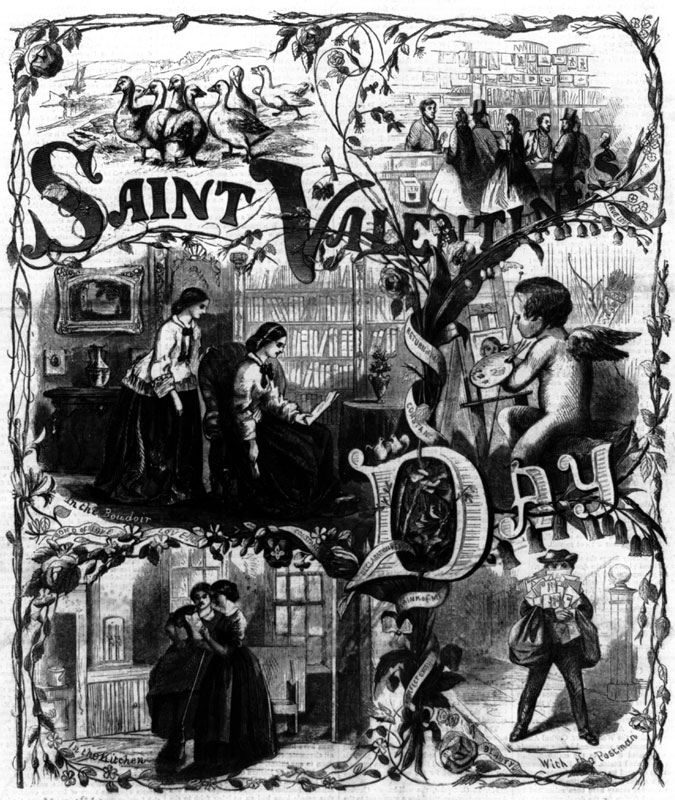
The History (or Histories) of Valentine's Day

A 1961 composite illustrating traditional
Saint Valentine's Day.
Illustration: Library of Congress.
In the February 2013 issue of the Marina Times in San Francisco, I investigate the history of the February 14th holiday.
EDITOR'S NOTE | BACK STORY
The Stories Behind St. Valentine's Day
By John Zipperer 
Hearts, cupids, boxed chocolates, and mailboxes stuffed with greeting cards are all signs that we’re approaching Feb. 14 or, more formally, St. Valentine’s Day. Americans will purchase 145 million valentine’s cards this year, the Greeting Card Association estimates, and we can add to that an uncounted number of electronic greeting cards. 
The holiday brings to mind childhood viewings of Charlie Brown’s V-day travails, and probably a mixture of ...

Anti-Boom and Anti-Bust

My latest article in San Francisco's Marina Times newspaper:
ECONOMY
As San Francisco Leads a New Economic Upswing in the State, It's Time to Act UnnaturallyBy John Zipperer 
The $25 million man, as I called him, was the symbol of California’s boom-or-bust economy. In the early 1990s, when California was struggling through one of its cyclical busts and commercial real estate in particular was hit hard, this man was $25 million in debt.
The $25 million man was a commercial real estate developer and consultant. He had rung up his debt during the go-go times of the late 1980s and very early 1990s, but when the market swung back — as it always will — he was ...

Saturday, January 26, 2013

News Quiz Time: Clinton and Kerry and McConnell and More, Oh My

It's my latest W2W News Quiz.

Here's a sample question: How did Senator John Kerry begin his comments to the Senate committee overseeing his secretary of state confirmation?

a. "I've never seen a more distinguished and better looking group of public officials in my life."
b. "Ask Osama bin Laden if he is better off now than he was four years ago."
c. "I'm John Kerry and I am reporting for duty."
d. "Domestic policy can only defeat us; foreign policy can kill us."

The answer to this – plus 10 other questions - can be found here.

Monday, January 21, 2013

Lucas and Musk and Weinbaum and Hatch and More

I've been hearing from readers near and afar about the third issue of my free digital science fiction & science magazine, Galaxis. Reminds them of the best of the old Starlog magazine. (Everyone knows I like to hear that kind of compliment.) Filled with great info. Give us more.

And so on. Blushing, I am appreciative of all of the people who have emailed, posted, and Facbooked about this third Galaxis issue.

And for those of you who have been waiting for an invitation, here you go. Here's a list of the entire table of contents (and you can click on the image below and see the entire magazine full-size on your computer).

FEATURES
Will We Ever See Blood & Chrome? The fans loved it, SyFy shelved it
Classic Battlestar Galactica Complete episode guide
SpaceX in Space Elon Musk makes private space travel work
The Magicians Meets the TV Gods Lev Grossman’s books get to TV – almost
The Wuxia Road to Star Wars Fans have heard the story’s roots lie in classic Japanese cinema. Look a little further west...
Star Wars in new media A guide to new generations of viewers catching the saga on Blu-ray & in 3-D
Can You Hate the Creator? Are the George Lucas-haters for real?
Another Earth There are those who believe that life out there began out there
FICTION: A Martian Odyssey 
Stanley Grauman Weinbaum’s pathbreaking short story about extraterrestrials
The View from CERN The center of the physics world—the center of the universe, in a way—is in Switzerland
The World According to Charles Yu The author of How to Live Safely in a Science Fictional Universe

DEPARTMENTS
Viewscreen Would Harry Potter lead you wrong?
Launch Tube Lucasfilm and Disney tie the knot, SF politicians, memories of Ray Bradbury, & more news
Imagery Patrick Stewart, and more Culture
Worldly Things Tablets, watches, and oodles of Google
Webbed Website resource
Compendium 
What to see, hear, and do
Game Set The Galaxis Crossword Puzzle and SF Quiz
ReviewScreen Prometheus, The Long Earth, The Incal, Chez Max, Measuring the World, Moebius & more
Next Issue 
The future in Galaxis

To read, click on the image below or go directly to issuu.com page for Galaxis 3.

Saturday, January 12, 2013

Just Think About All the Unemployed Death Star Workers

I, personally, am very happy and proud to be living in a nation where the presidential administration, even after making a bone-headed move like promising to respond to any ridiculous petition that gathers 25,000 signatures (which is nothing in the age of social media), employs someone who writes a response like this.

Paul Shawcross, chief of the Science and Space Branch at the White House Office of Management and Budget and the writer of the response, is a nerd, and my hero. Or he made great use of Wikipedia when he was writing the denial of the petition.

Republicans might complain that Obama missed an opportunity to add a Death Star to the military budget, and Democrats might complain that the White House passed up a great public works project that could have put to work thousands of people during the construction (not to mention afterward – someone was going to get the franchise for the Burger King in the Death Star food court).

But I have to agree with Shawcross that in these budgetary tough times, we have to put the Death Star on the back burner. Besides, we'll be too busy building a real-life starship Enterprise.