
Showing posts with label saturn. Show all posts
Showing posts with label saturn. Show all posts
Saturday, February 18, 2012
3,000 Very Smart Science Fiction and Science Fans Agree


Galaxis is the choice of the smart ones. The people who've read this free digital magazine – all devoted to science and science fiction – now number more than 3,000, which makes it even more popular than the first issue.
Friday, August 5, 2011
Pack Up the Bags, Honey, We're Going to Jupiter!
 |
| At Cape Canaveral Air Force Station's Space Launch Complex 41, a crane is lowered over the nose of the Atlas payload container enclosing the Juno spacecraft. Photo by NASA/Cory Huston |
Juno won't arrive at Jupiter until August of 2016, so don't sit at your computer waiting for the Jupiter pictures. (Actually, you should sit at your computer awaiting NASA news, but in the meantime, while Juno is wending its way to Jupiter, check out the Cassini-Huygens mission reports.) By the time Juno finally arrives at Jupiter (presumably wheezing from the effort of running the entire distance), it will survey Jupiter and its moons for a year to draw up a map of its magnetic field. One of the results hoped for is the answer to whether there is a solid core underneath Jupiter's swirling clouds.
"If we could start to understand the role that Jupiter played and how the planet formed and how that eventually governed the creation of the other planets and the Earth and maybe even life itself," the mission's principal investigator, Scott Bolton, told NASA, "then we know a little bit about how to look for other Earth-like planets, maybe orbiting other stars and how common those might be and the roles that those giant planets that we see orbiting the other stars play."
I'm somewhat mentally focused on the gas giants these days, because I've been working on a pictorial spread featuring Cassini's cool Saturn visit, which will appear in the second issue of Galaxis, my free digital science & science fiction magazine. Something else to keep you busy until August 2016.
 |
| NASA's Cassini spacecraft took this true-color simulated image of Jupiter in 2000. Jupiter's little moon Europa is casting the shadow on the planet. Photo by NASA/JPL/University of Arizona |
Thursday, April 1, 2010
The Starlog Project: Starlog #45, April 1981: Buck Rogers' Swan Song

Starlog #45
72 pages (including covers)
Cover price: $2.50
John P. Hogan, the inventor of the 3-D model kit in this issue, is actually making at least his third appearance in the magazine. His modular paper designs rated a Log Entries item years earlier, and a couple years earlier he reappeared in an item about a Starlog solar t-shirt he designed (which publisher Kerry O'Quinn modeled in a photo).
Kerry O'Quinn touts his company's various products in his From the Bridge column; Communications letters include definitions of science fiction, questions about Space: 1999, comments on space war, and more; Log Entries short news items include a first look at the King Arthur fantasy Excalibur, ChesleyBonestell's reaction to real pictures of Saturn, a Christian science-fiction story (The Namos Chronicles), the imprisonment of Russian SF author Oles Berknyk, and more.


Alan Brender interviews Thom Christopher, who plays the new Buck Rogers character Hawk in that show's second and final season; Bjo Trimble answers readers letters about Star Trek; David Gerrold makes the case that mankind has to get into space; James H. Burns previews Kingdom of the Dwarfs, a new book from David Wenzel; Samuel J. Maronie visits the set of John Carpenter's Escape from New York, one of the great low-budget SF films of the past few decades; Robert Greenberger previews Panic Offshore, a made-for-TV monster movie; the four-page paper 3-D model kit is introduced with a short article on creator John P. Hogan; there's also (on page 66) instructions for assembling the kit; Joseph Veverka completes his "Voyager View of Saturn" space science article; Robert Greenberger looks at the phenomenon of science-fiction art books; Alan Brender interviews writer/director Peter Hyams about his new film, Outland; Quest features the artwork of Benjie Small and the short-short fiction of Phil Yahnke; Ron Goulart's "SF in the Comics" series covers the science-fiction boom in the 1950s; David Hutchison's SFX section looks at the Flash Gordon movie's mattes; David Hirsch's In Syndication looks at how the Planet of the Apes was packaged; and Howard Zimmerman's Lastword column covers hopes for the space shuttle's inaugural launch.
"The Namos Chronicles is a filmstrip that has the makings of a science-fiction story. There's a planet, Namos, locked in battle against the evil Kaprians. There are spaceships and laser guns. Even alien monsters. What distinguishes Namos Chronicles from most other SF stories is that underneath the hardware are the parables of Jesus."
--Log Entries: "Scriptures in Space"To view previous Starlog issue descriptions, click on "Starlog Internet Archive Project" in the keywords below.
The Starlog Project: Starlog #44, March 1981: Houston, We Have a Problem

Starlog #44
68 pages (including covers)
Cover price: $2.25
It's a real-space-heavy issue, a true NASA-lover's delight. Meanwhile, the various controversies take a low profile this issue, as the magazine gets down to its usual bring-us-the-news business.
Publisher Kerry O'Quinn's From the Bridge column is a collection of reader letters (including someone accusing O'Quinn's editorials of ruining Starlog) and his responses; Communications letters include reader reactions to Howard Zimmerman's criticism of Cosmos, feedback on the magazine's 3-D coverage, and more; short news items in Log Entries include information about the upcoming Dino De Laurentiis Conan movie, a Howard the Duck lawsuit, DC Comics' Green Lantern Corps mini-series, and more.

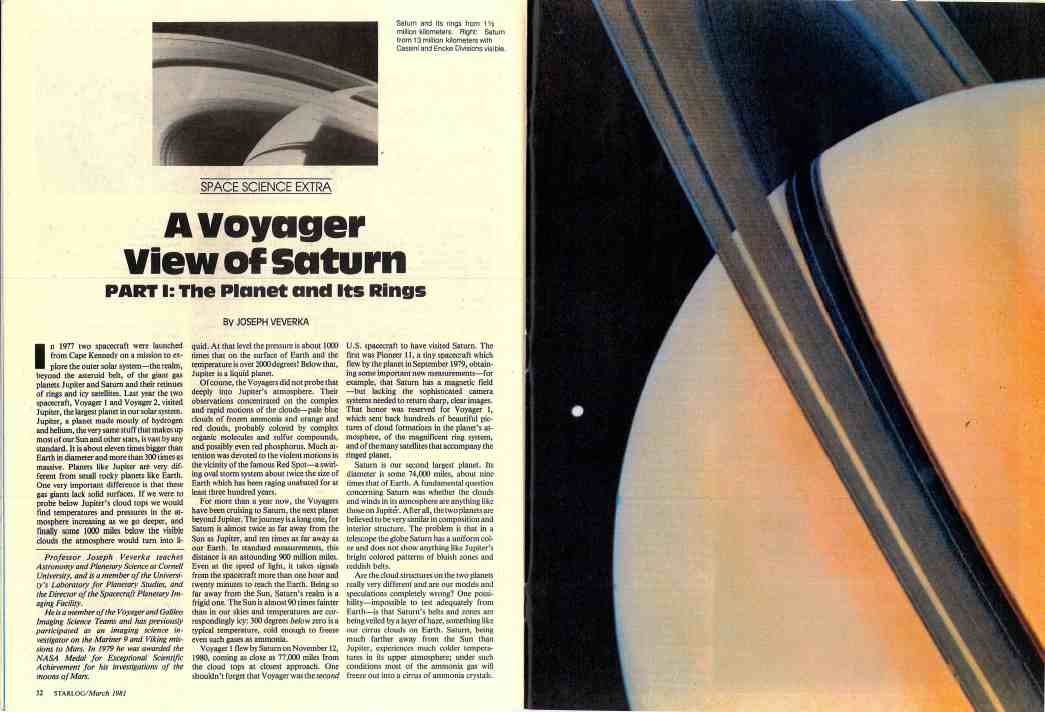 James H. Burns interviews Bob Balaban, star of Altered States; David Gerrold uses his Rumblings column to urge readers to actively support the U.S. space program; Alan Brender interviews Verna Fields, the studio executive behind The Incredible Shrinking Woman; Brender also pens a studio-by-studio roundup of science-fiction film and television productions that were affected by the 1980 actors strike; it's real-science time again, as Joseph Veverka steps into Jonathan Eberhart's sciency shoes and writes the first of a two-part feature on Voyager's trip to Saturn; Michael Smith previews the Disney Condorman movie; Suzanne Weyn profiles artist Walter Velez; Bjo Trimble's Fan Scene is the second blow of the one-two punch of Gerrold-Trimble this month, as she urges readers to write to politicians to get them to support space exploration; Bill Pearson and David Hirsch explore the miniature models used in the Flash Gordon movie; Ron Goulart goes "From Flash Gordon to Wash Tubbs" in part four of his "SF in the Comics" series; Alan Brender interviews Flash Gordon director Mike Hodges; David Hirsch's In Syndication column premieres, covering the syndicated world of genre programs; and Howard Zimmerman answers readers' criticisms of his negative take on Cosmos.
"The initial sequence saw Flash and Dale on Mongo being hunted as outlaws by the forces of Ming the Merciless, a price of 'a thousand gold mingols' on their heads. The first line Flash speaks sets the style for what is to follow for the next few years. As he pilots a rocketship, one-handed, toward a safer patch of territory, he says, with Dale perched on his lap, 'Alone at last!' Almost immediately, their ship explodes."
--Ron Goulart, writer, "SF in the Comics: Part IV: From Flash Gordon to Wash Tubbs"To view previous Starlog issue descriptions, click on "Starlog Internet Archive Project" in the keywords below.
Wednesday, October 7, 2009
Yet Another Ring Around Saturn Discovered -- Who Knew?

An artist's vision of the newly discovered ring around Saturn -- the planet's largest ring. The artist's conception simulates an infrared view of the giant ring. Saturn appears as just a small dot from outside the band of ice and dust. The inset shows enlarged image of Saturn, as seen by the W.M. Keck Observatory at Mauna Kea, Hawaii, in infrared light. The ring, stars and wispy clouds are an artist's representation. (Photo courtesy NASA/JPL-Caltech/Keck )
NASA discovered another humongous ring around the planet Saturn, this one so large it'd take 1 billion earths to fill it, notes USA Today's article on the subject.
Discovered by NASA's Spitzer Space Telescope, the humongo ring is so diffuse, it doesn't reflect much light and was only noticed by an infrared scan. According to NASA's announcement,
The discovery may help solve an age-old riddle of one of Saturn's moons. Iapetus has a strange appearance -- one side is bright and the other is really dark, in a pattern that resembles the yin-yang symbol. The astronomer Giovanni Cassini first spotted the moon in 1671, and years later figured out it has a dark side, now named Cassini Regio in his honor. A stunning picture of Iapetus taken by NASA's Cassini spacecraft is online at http://photojournal.jpl.nasa.gov/catalog/PIA08384 .
Saturn's newest addition could explain how Cassini Regio came to be. The ring is circling in the same direction as Phoebe, while Iapetus, the other rings and most of Saturn's moons are all going the opposite way. According to the scientists, some of the dark and dusty material from the outer ring moves inward toward Iapetus, slamming the icy moon like bugs on a windshield.
Subscribe to:
Posts (Atom)