Sunday, March 28, 2010

The Starlog Project: Starlog #36, July 1980: Four More Years!

Starlog celebrates the completion of its fourth year of life (and success) with another 100-page "SCIENCE FICTION SPECTACULAR," as it announces on the cover, before it starts loading on the exclamation points. Just like its third-anniversary issue, #24, this is a jam-packed magazine with the normal coverage of upcoming and current SF movie, TV, graphic, and literary efforts, along with a special 34-page color section that examines the past year in the genre.

Starlog #36
100 pages (including covers)
Cover price: $2.95

The cover design is a repeat of the blocked-photo layout last seen on the third-anniversary cover. We get another two-page From the Bridge column by publisher Kerry O'Quinn, but there's not a repeat of the two-page table of contents. (There is, however, another of Howard Zimmerman's photo collages illustrating the contents page.) Today it is not unusual for a niche-market magazine to have 100 or more pages in every issue (especially if it's published in the UK), but in 1980, it was a rare thing, certainly in the science-fiction media magazine field. So this special issue was an annual event.

Kerry O'Quinn's extra-long From the Bridge editorial looks at opening up avenues of exploration and intellectual stimulation — it's vintage O'Quinn, and in only the third issue of the magazine since I'd become a reader, it confirmed in my mind that this was my magazine, speaking to 12-year-old me; letters in the Communications section range from praise for the Tom Baker interview to comments on women in SF to follow-up on Rocky Jones to a high school mainframe computer user who discusses his Star Trek game; short news items in Log Entries include Star Wars characters guest starring on The Muppet Show, Bob Burns' time machine, Dr. Joseph Veverka on solar sails, an update on the Heavy Metal movie, first word on The Quatermass Conclusion, and more.

David Houston interviews Gary Kurtz, producer of The Empire Strikes Back (and who actually told Starlog, "Here's how it goes. There are nine stories: three trilogies of three stories each. Star Wars was the first story in the middle trilogy." Oops.); David Gerrold's Rumblings column "The Write Way," offers writing suggestions -- and he begins by relating his rejection of a young writer who asked for help, saying he can't offer it, yet then he goes on to offer writing help -- vintage Gerrold; Karen E. Willson interviews Star Trek's Nichelle Nichols; Willson also interviews Glen Larson, producer of Battlestar Galactica and Buck Rogers in the 25th Century (I'll bet he leaves Galactica 1980 off his resume).

In the special anniversary section, Samuel J. Maronie provides an overview of science-fiction television in the 1979-1980 season; there are photo reviews of recent films Alien, Star Trek -- The Motion Picture, The Black Hole, Saturn 3, Moonraker, and The Empire Strikes Back; there's a two-page SF collage by Howard Zimmerman (a detail of which was shown on the contents page); famous science-fiction professionals send in their anniversary congratulations to the magazine (such as illustrations by Jack Katz and Howard Cruse or Buster Crabbe's "Congratulations on your first four years. Yours has been an excellent job"); Jonathan Eberhart writes about the future of exploration in the solar system; a four-page space art section highlights some beautiful paintings by artists David Hardy and Gary LaSasso; Karen Willson and David Heath provide a roundup of upcoming science-fiction and fantasy offerings from the various production studios; Susan Adamo and John Clayton (who would soon be named the magazine's staff photographer, but is only listed as a contributor this issue) provide a three-page topic index to the last year of Starlogs.

Susan Adamo also interviews Durinda Rice Wood, the costume designer for the Battle Beyond the Stars motion picture; Gerry Anderson's Space Report completes its look at "The Mysterious Unknown Force," this time by printing letters from readers offering their interpretations; David Houston interviews Tom Leetch, co-producer of the Disney movie The Watcher in the Woods, starring Bette Davis; Samuel J. Maronie interviews Yvette Mimieux, star of The Black Hole; David Prowse (aka Darth Vader) is back for his third Starlog interview, armed with more complaints against the producers -- this time he's interviewed by David Hirsch; Frank Winter explores "Ye Olde Space Music," scores for classic SF films; an unbylined article examines science-fiction games; Al Taylor, Bill Hume and Mike Smith team up to write "Alien Worlds: Science Fiction Radio Rides Again"; David Houston's Visions column continues his look at "The Visual Art of SF Cinema" by examining the art of freeze frames ("... single shots that contain so much information, or information of such startling quality, they seem to slam right into the subconscious center of emotions"); and editor Howard Zimmerman uses his Lastword column to offer the First Annual Zimmerman/SF Awards (let's just say that Meteor does not fare well).
"Starlog, from the very start, set as one of our prime editorial goals, to be an intellectual inspiration to our readers. ... [W]oven into the fabric of the magazine, is an attitude toward new ideas, toward intellectual explorations, toward creativity and a bold, positive approach to life. This attitude is a vitally important ingredient of our publishing philosophy and, I believe, of our success."
--Kerry O'Quinn, publisher, From the Bridge: "Opening Doors"
To view previous Starlog issue descriptions, click on "Starlog Internet Archive Project" in the keywords below.
Barack Obama on Classic Episode of Check Please


Quick quiz: When did Barack Obama say: "I've learned from some past mistakes that you've got to be cautious."

  • After he got kicked around by the Republicans on health care?
  • After he got kicked around by Hillary Clinton in the primaries?
  • After his first foreign policy initiatives ran into the rocks?

No, in the quote above he is referring to his proper allotment of appetizers at a restaurant in the Hyde Park neighborhood of Chicago. It was from the 1990s when he was a state senator in Illinois, and he was a guest on the public broadcasting restaurant-review program Check Please. Reportedly, this episode was never aired, in part because the future senator/president/messiah ... er, um, talked too much. I don't know if that's true, but I've heard it multiple times.

The Starlog Project: Starlog #35, June 1980: The Year of Empire!

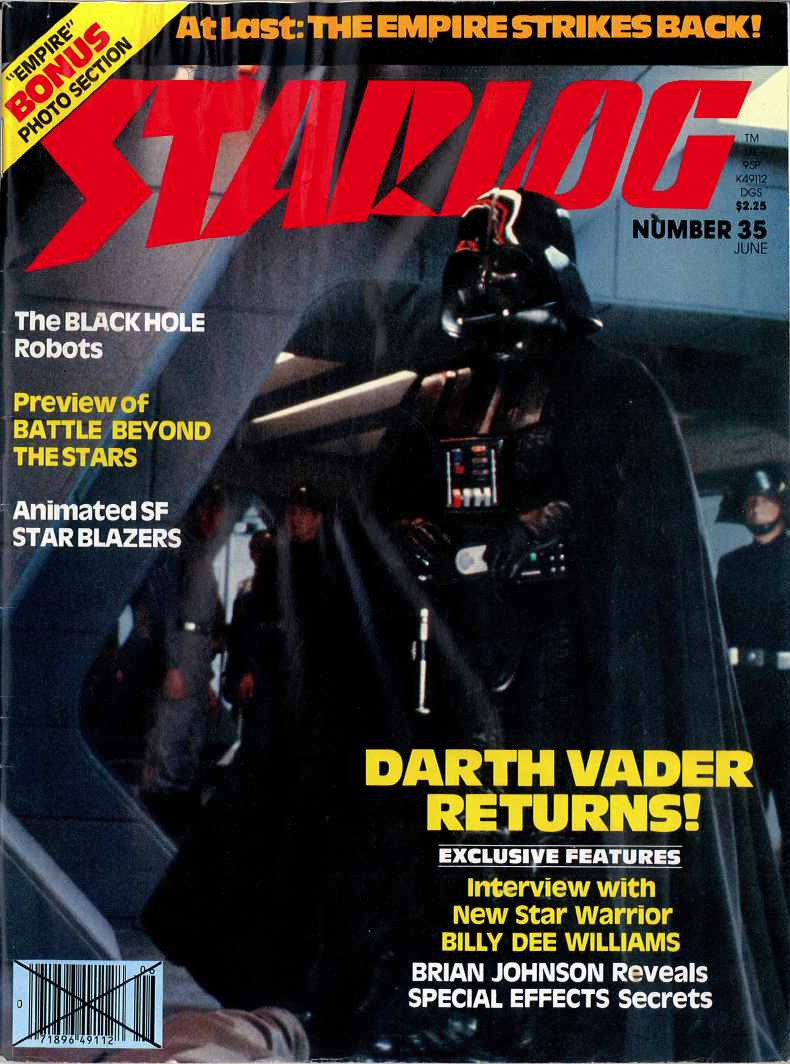
Okay, so technically this is the final issue in the Year of Trek at Starlog, but The Empire Strikes Back struck a month early. Over the next year, Empire would command three of the magazine's covers (including one of my all-time favorites, which comes up in two months) and countless articles. After Star Trek -- The Motion Picture had its 11-month year in the sun, the Star Wars sequel moves in. Unlike Trek, Empire would be almost a complete critical success. Science-fiction magazines like Starlog live and die by how they latch onto the big movies and TV hits of of the day, so it's natural for its editors to pivot quickly to a galaxy far, far away ...

Starlog #35
72 pages (including cover)
Cover price: $2.25

As the cover's roof text declares: At Last: The Empire Strikes Back! That enthusiasm is spread throughout the issue, which includes an extra four-page photo spread from the movie (and if you've ever been in magazine publishing, you know it is usually not financially feasible to add four pages instead of eight, just because of the way the printing presses work). But there's other interesting stuff in this issue, including a good long look at Star Blazers (aka Space Cruiser Yamato) and previews of many upcoming productions. Also this issue, we have the first appearance of another extension of the Starlog brand: Starlog Video, classic SF TV and movies on VHS or beta (for only $59.95 each!! -- oh, those early days of home video!). A very cool idea, though expensive and ahead of its time. By the time home video hits big in a few years, Starlog Video will have been long gone. Also this issue is the first notice of Starlog Records' latest release, and it's a coup: Bernard Herrmann's score for the Hitchcock classic North by Northwest.

Kerry O'Quinn kicks off the party in his From the Bridge column by exploring "Invisible Death," really a continuation of his "Dreams" theme about the need to pursue dreams and to not let other people deter you from your passions; Communications letters include the first fiery batch of reader responses to Harlan Ellison's (and David Gerrold's and Howard Zimmerman's) negative review of Star Trek -- The Motion Picture, as well as the evergreen complaint that Starlog disses non-Trek TV shows, reactions to Galactica 1980, and more; Short news items in Log Entries include a call for SFX help on the TV special The Tears of Thoria, reprints of the UK comics hero Dan Dare, new Bugs Bunny shorts, Kenner's Empire Strikes Back toys, announcement of th second annual Short Film Search, and more.

Alan Brender interviews George McGinnis, designer on the Disney SF film The Black Hole; Karen E. Willson interviews Bruce Lansbury, supervising producer for Buck Rogers in the 25th Century (and which, in a photo, reminds us all that the late actor Peter Graves guest starred on that show); David Gerrold's Rumblings discusses how Hollywood misses the magic when it brings science-fiction stories to the screen; Bill Cotter & Mike Clark share an extensive background on a classic (to some) TV series and movie, "Up from the Depths: The Making & Breaking of Voyage to the Bottom of the Sea"; Gerry Anderson's Space Report covers "The Mysterious Unknown Force, Part II"; David Houston kicks off the Empire coverage by interviewing SFX co-supervisor Brian Johnson (the article includes the four-page bonus photo section, illustrated with some of the movie's scenes that would become iconic); Bob Woods continues the fun with his interview with Lando Calrissian himself, Billy Dee Williams; an unbylined one-page article updates readers on happenings at the Star Wars Fan Club (which also advertises earlier in the magazine; draw your own conclusions); the Quest reader-talent page includes Doug Chaffee's illustrations (quite good, I might add); David Houston writes a preview of Universal Pictures' slate of productions for 1980, which include "More Fuel for the Science-Fiction Boom" (such as Flash Gordon, the Get Smart movie The Nude Bomb, and more); James H. Burns introduces American audiences to a Japanese classic in "SF Animation at Its Best: Make Way for Star Blazers"; Susan Adamo's first feature article is a preview of Battle Beyond the Stars, in which she interviews director Jimmy Murakami about this Roger Corman SF remake of The Seven Samari (scripted by John Sayles and starring Richard Thomas); F.W. Evans writes this month's SFX section, focusing on "The Crew" -- a behind-the-scenes look by a special effects crew member at the miniature work on Steven Spielberg's 1941; David Houston's Visions column looks at the visualization of William Cameron Menzies' Invaders from Mars; and Howard Zimmerman's Lastword sort of echoes Gerrold's column by talking about the compromises made in bringing good SF to the screen.
"Despite Star Blazers' American hassles, Space Cruiser Yamato continues to be one of Japan's most popular television shows. Yoshinobu Nishizaki has just finished production on 26 new episodes that reportedly depict Desslok and the Star Force uniting against a common enemy that threatens the existence of both humans and Gamilons. Marcella would eventually like to import this third season, but is currently going to concentrate on getting Star Blazers seen by a wider segment of the American public."
--James H. Burns, writer, "SF Animation at Its Best: Make Way for Star Blazers"
To view previous Starlog issue descriptions, click on "Starlog Internet Archive Project" in the keywords below.

Saturday, March 27, 2010

New Doctor Who on Cover of UK's Gay Times

It's a triple-whammy for this blog: Science fiction, gays, and magazines. Three of our favorite topics.

DoorQ has this preview of the new issue of Britain's Gay Times magazine, featuring on the cover the new actor to portray Doctor Who, Matt Smith.

If DoorQ can mix science fiction and homosexuality, then shouldn't GT be able to do it?

The Starlog Project: Starlog #34, May 1980: My First Starlog

Okay, here it gets a bit personal. It goes back to Stangel's Super Valu grocery store in Manitowoc, Wisconsin. I, a 12-year-old science fiction fan, had been eyeing and paging through the Starlogs and Fantastic Films and Future Lifes at the magazine rack for months, but only now ("now" being April 1980) did I save up enough of my weekly allowance to purchase a copy of Starlog. I was hooked instantly, and I was a constant reader for three decades until the magazine closed in 2009. I absolutely absorbed Starlog #34, and decades later I could still recount many of the articles even without picking up the issue. The reason wasn't quite as pathetic as it sounds; I did have a life, but in Starlog I found two things: a magazine devoted to something I was beginning to get into big-time (i.e., science fiction), and a publication that wasn't afraid to challenge me and take me outside of my comfort zone. The only downside of this is that this issue was devoted to Galactica 1980, and I'd love to say that I was so precocious as a 12-year-old that I knew that the original Galactica (not to mention the 1980 rebirth) was silliness; but the truth is that even with a dozen years under my belt, I was totally swept away with the saga and the mythos of Battlestar Galactica. I did understand that Galactica 1980 was a low-budget and poorly constructed retread of the show, so give me that. But still, that color shot on the cover of the Galactica being attacked by a Cylon fighter -- well, I just had to have that magazine.

Starlog #34
68 pages (including covers)
Cover price: $2.25

Starlog #34 includes a neat free insert: a Star Wars cast photo, and -- on the other side of the binding -- a Fangoria Count Fangor bookmark. Otherwise, it's a Galactica- and Empire-heavy issue. Perfect food for a 12-year-old science-fiction fan in 1980. Also, an armload of new Starlog photo guidebooks are advertised: Spaceships (the expanded edition), Science Fiction Heroes, Special Effects Volume II, and Science Fiction Villains.

If you like Cylon raider photos, such as the one on the cover, you'll geek out over the contents page photo of raiders among the clouds; Kerry O'Quinn's From the Bridge is another Grab Bag Notes column, this time covering everything from digital recordings, to reader reactions to his previous columns, to why he's adding a comic strip to his Fangoria magazine (over the objections of Fangoria's editor, "Uncle Bob" Martin); reader letters in the Communications pages include reactions to O'Quinn's "Dreams" editorial, thoughts on Galactica 1980, playing the recent special effects record, and more; Log Entries is filled with short news items such as a report on Forrest J. Ackerman's science fiction museum, first news of Roger Corman's Battle Beyond the Stars, Howard Cruse releases a new edition of his Barefootz Funnies, the death of Don Post Sr., and more.

Karen E. Willson interviews Robyn Douglass, who plays Jamie on Galactica 1980; Willson also interviews Robbie Rist, who might well be a wonderful person but who played the annoying Doctor Z on Galactica 1980; David Gerrold discusses writing, and he begins his column with the words that introduced me to Harlan Ellison ("Harlan Ellison once said that a fresh litchi nut is the third best thing in the world. I thought for a moment, then asked, "What's the second?" "Sex, of course." "Oh -- then, what's the first?" He blinked. "David, I'm surprised at you! It's writing!"); David Houston interviews Empire Strikes Back director Irvin Kershner; Bjo Trimble's Fan Scene highlights the Fantasy Artists Network; Jonathan Eberhart's Interplanetary Excursions, Inc., visits the Martian moon of Phobos; the Quest page includes some Australian readers who make SF models; a two-page color photo spread revisits The Martian Chronicles; Karen E. Willson interviews Tom Baker, Britain's Doctor Who; Alan Brender reports from the first Doctor Who convention in North America; Gerry Anderson's Space Report has the first part of "The Mysterious Unknown Force"; Samuel J. Maronie interviews Felix Silla, who plays the uber-annoying Twiki on Buck Rogers in the 25th Century; David Houston writes the SFX section, looking at the Halloween production of Bob Burns; David Houston's Visions column looks at the work of William Cameron Menzies; and Howard Zimmerman's Lastword covers some of the many flaws in Galactica 1980.
"You know, when I got the character I was desperately out of work and glad to have the contract. Fortunately, I signed the contract before anybody else did. I remember the wonderful feeling I had when I signed this beautiful contract, which was going to put me into television history because of the formula. Even if I had been a disastrous failure I would have gone into history as the first failure, because no one has failed Dr. Who."
--Tom Baker, actor, interviewed in "A Visit with The Doctor (Who): Tom Baker"
To view previous Starlog Archive issues, click on "Starlog Internet Archive Project" in the keywords below.

The Starlog Project: Starlog #33, April 1980: Harlan Ellison Smashes Star Trek

In many ways, this issue is what a great science fiction media magazine should be. Even covering some less-than-stellar SF productions (The Black Hole, Saturn 3, Voyage to the Bottom of the Sea), Starlog does a good job of getting the goods and informing and entertaining its readers. Throw in some high-impact controversy, a little science, a new column by Bjo Trimble, and an episode guide, and you've got an issue so strong the reader doesn't mind the recent hike in cover and subscription prices.

Starlog #33
76 pages (including covers)
Cover price: $2.25

Harlan! Ellison! Reviews! Star! Trek! Okay, Starlog didn't use the exclamation marks when it put that statement in the roof text on the cover, but it might as well have. This would prove to be arguably the most controversial article in Starlog's history, and deservedly so. After all, some of the other controversies (such as Ellison vs. Mark Hamill) simply really didn't matter beyond the spectacle of famous people arguing. But the multi-issue brouhaha that would ensue from Ellison's negative review of Star Trek -- The Motion Picture was important, because it got to the heart of whether SF fans (and Starlog) just placidly accepted whatever was handed to them by the movie studios, and whether they could handle criticism with which they didn't agree, and whether Gene Roddenberry could be called on the carpet in front of his most fervent fans. What's sometimes overlooked is that this issue also included negative Trek reviews from Howard Zimmerman and David Gerrold, but -- though there are plenty of Gerrold detractors out there -- Harlan Ellison is in a category all his own. A side note: Ellison's review in this issue would lead to him pitching a movie column to Starlog, but he was instead offered a regular slot in sister magazine Future Life, where beginning later this year (1980) he would begin an excellent column (his best nonfiction since The Glass Teat years, in my opinion) that would run until that magazine's untimely death a couple years later. It's worth searching for Ellison's collection of those columns in book form, An Edge in My Voice.

Kerry O'Quinn uses his From the Bridge column to talk about true success (and no, it's not about money); Communications letters include two full pages of positive and negative reader reviews of Star Trek -- The Motion Picture, plus some thoughts on The Black Hole and praise for the magazine's 1980 Space Art Calendar from greats Chesley Bonestell and Ludek Pesek (the latter writing from Switzerland); short Log Entries news items include more on The Empire Strikes Back, Captain Kangeroo's Robot B1, artist Wayne Barlowe's extraterrestrials guide, the premiere of the Star Trek movie, Galactica 1980, and more.

Alan Brender interviews producer and director Stanley Donen in his Saturn 3 preview; David Gerrold's Rumblings reviews Star Trek -- The Motion Picture ("When the film was over, there was half-hearted applause. And the professionals walked out without waiting for all the credits. A bad sign that."); scientist Jesco von Puttkamer shares his 1978 memorandum to Gene Roddenberry about how a wormhole functions; Samuel J. Maronie interviews Dr. William J. Kaufman, who -- in the wake of Disney's The Black Hole film -- talks about real black holes in space; fan extraordinaire Bjo Trimble (the woman who led the letter-writing campaign that saved the original Star Trek television series) launches her new column, Fan Scene, which takes the place of former columnist Susan Sackett's Star Trek Report; David Houston examines "The Kids from KAOS or The Not Ready for Reality Players"; Mike Clark and Bill Cotter make their first appearance in the magazine by researching and writing the complete episode guide to Voyage to the Bottom of the Sea, printed on an eight-page yellow-pages insert; Samuel J. Maronie interviews veteran actor Maximilian Schell, who plays Dr. Hans Reinhardt in The Black Hole; Karen E. Willson talks with Bob Fletcher, costume designer for the Star Trek film; reader talents on view in the Quest pages include a poet and an SF model maker; Harlan Ellison reviews Star Trek -- The Motion Picture across three glorious black-and-white pages, and the world would never be the same; James H. Burns (aka Jim Burns) examines Star Trek comic books; Gerry Anderson's Space Report looks at Barry Gray's music; David Hutchison looks at Joe Hale's animation that makes special effects come to life in movies; David Houston re-assumes control of his Visions column by looking at "The Visual Art of Science Fiction Cinema"; and editor Howard Zimmerman wraps up a busy issue with his own intelligent reaction to the Star Trek movie.
"The mark of Gene Roddenberry's limits as a creator of stories is heavily, indelibly, inescapably on this production. ... The script has all the same dumb flaws that were perpetrated in the series ... with bigger, prettier pictures. ... The basic story, for all its 'latest state of the art' and its tricked-up trekkiness, is Gene's standard idea, done so often in the series: we go into space, we find God, and God is (pick one) malevolent, crazy, or a child."
--Harlan Ellison, writer, "Ellison Reviews Trek"
To view previous Starlog Archive issues, click on "Starlog Internet Archive Project" in the keywords below.

The Starlog Project: Starlog #32, March 1980: Designing Star Trek

Starlog's innovation shows its head again with the inclusion of a bonus 33-1/3 rpm flexible record of science-fiction sound effects (between pages 18 and 19), created by Kenneth Walker, the magazine's director of special projects. Hence the higher cover price; in fact, the regular cover price will jump 30 cents with the next issue.

Starlog #32
68 pages (including covers)
Cover price: $2.95

Yes, it's more Year of Trek, with a cover photo of Captain Kirk in front of V'ger, the only galactic planet-gobbling super-robot too stupid to wipe a bit of dirt off its nameplate and realize its full name is Voyager.

Kerry O'Quinn's From the Bridge column takes on one of his favorite topics, the importance of having and pursuing one's dreams; Communications letters include Moonraker stunts, homemade Nostromo ships, Rocky Jones: Space Ranger, replies to an earlier letter writer's disdain for rock and disco music, and more; short entries in the Log Entries section include notes about Galaxina, merchandising The Black Hole, Gary Coleman guest stars on Buck Rogers in the 25th Century, and more.

David Houston interviews Star Trek illustrator Maurice Zuberano; Kenneth Walker writes this issue's SFX section, on "Sound Effects: The Electronic Age"; David Houston interviews designer Andy Probert about "The Lost Designs of Star Trek -- The Motion Picture" (with, as you'd expect, some great illustrations and set designs); David Houston shows how the tidal wave special effect was accomplished in Meteor; the Quest department premieres, in which Starlog publishes original amateur text and images by its readers, and this month it features Tracy Warren's designs for NASA exploration vehicles; David Houston interviews Buck Rogers in the 25th Century art director Paul Peters; Alan Brender interviews Trish Stewart from Salvage 1; Gerry Anderson's Space Report column has illustrations and details on the Mark IX Hawk ship; David Gerrold's Rumblings column explains "Starpool"; Walter Koenig's final chapter of his Chekov's Enterprise excerpt is published; Howard Zimmerman takes over the Visions column for the third installment of the look at artificial intelligence, "Robots, Androids and Cyborgs"; and then in his Lastword column Zimmerman provides "A Few Words About UFOs" from a skeptic's point of view.
"Now, don't get me wrong ... I'd love for these sightings to truly be starships bearing superior, enlightened beings. When I was a child I dream constantly (mostly in school) about just such an occurance. To this day I spend many summer evenings at the seashore, my back to the dunes, staring up at the night sky ... hoping. But really -- the odds against little green men from Alpha Centuri (or Zeta Reticuli) paying us a visit in a spaceship are infinitesimal."
--Howard Zimmerman, editor, Lastword: A Few Words About UFOs"
To view previous Starlog Archive issues, click on "Starlog Internet Archive Project" in the keywords below.

The Starlog Project: Starlog #31, February 1980: Into The Black Hole

Susan Adamo, a future managing editor of the magazine, is now sharing "associate editor" listing with Fangoria's Robert Martin. And it's just in time for Starlog #31, a Disney-heavy issue. (Okay, there's no connection that I know of between Adamo and Disney.) Also this issue includes the annual postal statement of ownership and circulation. So, as I did with its first appearance in issue #19, here are the main stats: The paid circulation for the issue closest to the statement's filing deadline is listed as 145,637 (a drop of about 50,000 from the previous year), including the number of paid subscriptions of 19,000 (drop of about 4,000).

Starlog #31
68 pages (including covers)
Cover price: $1.95

Disney's attempt to enter the big-budget science-fiction sweepstakes with The Black Hole is featured on the cover of this issue. Disney's movie wasn't a big hit, though there are plans afoot three decades later to film a remake of the movie. This issue also features a bit of design re-jiggering, with the column and department headings simplified (or boring-ified, if you're catty). Check out what I mean at the top of the SFX article included in this post.

Kerry O'Quinn's From the Bridge article is headlined "Touching Each Other," and it features stories about people who were positively affected by Starlog's publications, including the gay youth who says Davd Gerrold's Future Life article about anti-gay legislation in California is the reason he's still alive today; Communications letters include accusations of male chauvinism, additional Wonder Woman episode descriptions, promises of survival for Han Solo, and more; short Log Entries news items include a check-in with Harlan Ellison, a statement from Tom Baker (the then-current Dr. Who), PBS' Lathe of Heaven, and more.

Gerry Anderson's Space Report answers more reader questions (about music for Space: 1999, the disappearance of Space's regular actors in some episodes, and Tony and Maya's love. Aww.) David Houston interviews Disney executive vice president Ron Miller (not to be confused with Starlog's space art advisor, also named Ron Miller) about his company's Black Hole gamble; David Gerrold's Rumblings features the excerpt of a chapter from his new Star Trek novel, The Galactic Whirlpool; David Houston provides a roundup about all of the Empire Strikes Back rumors (such as Boba Fett's background, or with whom Princess Leia will fall in love); it's part two of Walter Koenig's Chekov's Enterprise excerpt; Alan Brender interviews The Black Hole star Joseph Bottoms; Jonathan Eberhart's Interplanetary Excursions, Inc., returns with "Port of Call: Stickball in Stickney"; a list of winners -- with some illustrations -- is printed from the submissions to the magazine's recent design-a-Starlog-pinball-machine contest; Bob Woods previews Elfspire; David Houston interviews film musician Miklos Rozsa; David Hutchison's SFX section looks at the special effects in Disney's 20,000 Leagues Under the Sea; Mike Jittlov writes about Disney's Major Effects, which stars Joseph Bottoms (he of The Black Hole, interviewed earlier in this issue); David Houston's Visions column continues his examination of artificial intelligence with a look at the Colossus trilogy; and editor Howard Zimmerman's Lastword reviews a year in science-fiction television.
"[Joseph] Bottoms admits there are some similarities to Star Wars in this film, but there are also many differences. 'The robots are cuter. They have big wide eyes and look more like Mickey and Minnie Mouse -- very Disney. And there's no maiden in distress.'"
--Alan Brender, writer, "Joseph Bottoms: The Space Cowboy in Disney's The Black Hole"
To view previous Starlog Archive issues, click on "Starlog Internet Archive Project" in the keywords below.

The Starlog Project: Starlog #30, January 1980: The Year of Trek Continues

As we move further through Starlog's fourth year of publication, it becomes increasingly clear that the magazine's design is becoming more standardized and, yes, a bit more boring. (As I noted in a previous issue post, my favorite design period was by previous art directors Howard Cruse and Robert P. Ericksen.) That's not to say the magazine is looking bad. Quite the contrary: It is a well put-together magazine that was head-and-shoulders above any of its competition on the newsstand. I only mourn the loss of some of the more innovative layouts of earlier years. In the magazine's art staff's defense, they were no longer just putting out one or two magazines; Starlog was now publishing monthly, it had its eight-times-a-year sister magazine Future Life, its bimonthly little brothers Fangoria and Cinemagic, plus poster magazines, trade paperback photo guidebooks, one-shot specials such as the John Wayne magazine, special projects such as the Communications Handbook, a 1980 calendar of space art, and licensed movie magazines and posterbooks (such as the 1941 magazine and posterbook, advertised for the first time in this issue, on page 10; by the way, a few years later, we'd learn that the company lost a ton of money on the 1941 products). So even though the magazine's art staff had grown, it was being tasked with producing a lot of material. That's how small publishing houses operate, and Starlog knew how to do it well.

Starlog #30
68 pages (including covers)
Cover price: $1.95

The Year of Trek continues at Starlog, with an iconic Trek photo on the cover (a photo that would be flipped over and used again on the cover of the first Starlog Scrapbook photo magazine in a year or two, and that was used -- in its flipped version -- on the cover of the Japanese edition of Starlog). The magazine also has quite a coup with the first of three excerpts of actor/writer Walter Koenig's book, Chekov's Enterprise.

The contents page photo is a beautiful shot of the Enterprise in dry dock. Kerry O'Quinn's From the Bridge column is a grab bag of notes on different topics, which is probably why it's called "Grab Bag Notes"; Communications reader letters include William F. Nolan taking credit for a space comedy script mentioned in a previous issue, Brick Price explaining at length the Star Trek special effects debacle, and even someone's report on their summer vacation. Log Entries short news items include a production report on The Empire Strikes Back, a roundup of British science-fiction television programs, two fans who had a Star Wars-themed wedding, and more.

David Houston interviews Robert Wise, director of Star Trek -- The Motion Picture; Alex York provides a retrospective of a different Gene Roddenberry production, the stillborn effort The Questor Tapes; Walter Koenig's diary from the Star Trek movie, Chekov's Enterprise, begins its three-issue serialization; "Great Moments in Science Fiction" is an illustrated two-page feature; David Gerrold's Rumblings estimates how much the Trek movie will have to earn at the box office to cover its bloated budget; Gerry Anderson's Space Report this month is a one-page photo feature of Martin Bower's miniature work from Space: 1999; David Houston interviews Star Trek -- The Motion Picture production designer Harold Michaelson; Karen E. Willson profiles female stuntwomen; David Hutchison's SFX article explores the art of the matte-scan (focusing on Harrison Ellenshaw); David Houston's Visions column explores "Artificial Intelligence: The Rulers of the World" (obviously including HAL 9000 in the mix); and Howard Zimmerman ends the issue with thoughts on the meaning of the new Trek film.
"At $42,000,000, Star Trek will be the most expensive motion picture ever filmed inside the continental United States and the third most expensive motion picture in history; Cleopatra cost $44,000,000, and the Russian version of War and Peace cost $100,000,000. ... Star Trek is going to have to earn at least $84,000,000 and maybe as much as $126,000,000 (depending on the various deals involved) before it actually shows a profit."
--David Gerrold, columnist, Rumblings: "The Bottom Line"
To view previous Starlog Archive issues, click on "Starlog Internet Archive Project" in the keywords below.

Friday, March 26, 2010

The Starlog Project: Starlog #29, December 1979: Meteor and Other Disasters

This issue of Starlog is sobering, and not just because of the crap disaster movie on the cover. Kerry O'Quinn shares a tragic story of an SF fan's needless death -- not his usual optimistic-overload. On a lighter note, we see the first ad for Starlog's Official Communications Handbook, which I continue to argue was a unique and smart publication by Starlog.

Starlog #29
76 pages (including covers)
Cover price: $1.95

I should really read the small print more often. For years, I had thought the cover art on Starlog #29 was studio-provided promotional art for the movie Meteor. But on page 4, the "About the cover" note informs us that it is in fact a painting by space artist (and Starlog's own space art advisor) Ron Miller.

Kerry O'Quinn's From the Bridge column tells about a teenage boy who was so wrapped up in his favorite TV show, Battlestar Galactica, that he jumped to his death when the show was canceled; Communications letters include a Canadian complaining about the inclusion of articles about rock and disco in Starlog and Future Life, conflicting opinions on Alien, convention reflections, and more; short news items in Log Entries include the return of Duck (that's Duck not Buck) Dodgers, the apparent kibosh on a Galactica TV special, first news of Carl Sagan's upcoming incredible Cosmos series on public television, photos of David Prowse arm-wrestling various Starlog staffers (he wins, except against Susan Sackett), Kerry O'Quinn is attacked by an Alien face-hugger, and more.

David Houston kicks off the Meteor coverage with a report from his visit to the movie's set; Jeff Szalay interviews Ted Parvin, Meteor's producer; Alan Brender interviews Erin Gray, who played Wilma Deering on Buck Rogers in the 25th Century; Susan Sackett's Star Trek Report explains what the movie's cast has been doing since they finished shooting the film (Grace Lee Whitney recorded some of her original music, for example); David Hirsch writes a Space Report Extra profiling Space: 1999 miniature maker Martin Bower; the Third Annual Science-Fiction Merchandise Guide fills eight yellow pages inserted in the middle of the magazine; Doug Crepeau writes about Dean Jeffries, who makes futuristic vehicles for science-fiction movies and television programs; David Gerrold's Rumblings column covers "Making Your Own Movie -- or -- The Impossible Dream"; David Houston gives a behind-the-scenes look at the "Mork in Wonderland" episode of Mork and Mindy; Tom McDonough is back with "Unidentified Talking Objects," so you better hope the readers who didn't get his previous satirical article have smartened up since then; Alan Brender interviews Buster Crabbe, the original Buck Rogers and Flash Gordon (and guest star on an episode of the new Buck Rogers in the 25th Century); Al Taylor and David Hutchison continue their extensive SFX profile of British special effects master Les Bowie (complete with an extensive filmography listing); for the first time in recorded history, Starlog features a poem, editor Howard Zimmerman's "Starlust" (illustrated by the great Jack Katz) on page 70; David Houston's Visions column looks at "Artificial Intelligence: Before the First Generation"; and Howard Zimmerman wraps it up with his Firstword column explanation of the magazine's forays into poetry and satire.
"[Buster] Crabbe almost had a small part in Star Wars, and regrets not getting it. 'Lucas,' he explains, 'suggested to the production department, "Why don't you fly Crabbe over? We'll set him in with all the characters from the bar." But they didn't buy the idea. I would have done it for nothing -- just the transportation -- to be in the film."
--Alan Brender, writer, "The New, Original Anthony Rogers -- or -- Two Bucks in the 25th Century
To view previous Starlog Archive issues, click on "Starlog Internet Archive Project" in the keywords below.